






India is stepping up its fight against rising cyber financial frauds with a new artificial intelligence-led initiative aimed at identifying and eliminating mule accounts across the banking ecosystem.
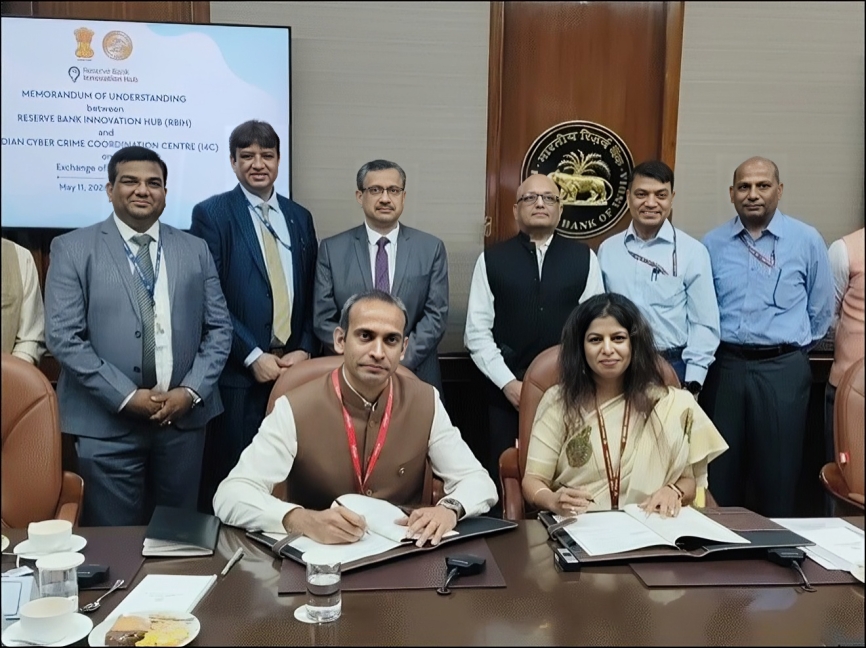
The Indian Cyber Crime Coordination Centre (I4C), operating under the Ministry of Home Affairs, has signed a Memorandum of Understanding with Reserve Bank Innovation Hub (RBIH) to strengthen AI-driven fraud detection and improve coordination against cyber-enabled financial crimes.
The MoU was signed by Roopa M, IG (Admin), I4C, and Sahil Kinni, CEO of RBIH, in the presence of senior officials including Reserve Bank of India Deputy Governor Rohit Jain, Special Secretary (IS) Anand Swaroop, Joint Secretary (CIS) Rakesh Rathi and Rajesh Kumar, CEO of I4C.
The partnership comes at a time when digital payment frauds, phishing attacks, fake account networks, and mule account misuse are becoming major concerns for India’s rapidly expanding digital banking ecosystem.
Union Home Minister Amit Shah said the government is continuously working toward building a “cyber secure Bharat,” describing mule accounts as one of the biggest operational challenges in curbing online financial crimes.
Under the agreement, I4C will share intelligence and suspect identifiers from its Suspect Registry with RBIH to strengthen AI-powered fraud monitoring systems such as MuleHunter.ai™. The platform is designed to identify suspicious banking patterns and hidden mule account networks before large-scale frauds occur.
The collaboration is expected to improve fraud-risk intelligence sharing, operational coordination, and real-time analytical support across banks and digital payment institutions.
Officials believe AI-driven systems can significantly improve the speed and accuracy of detecting fraudulent financial behaviour, particularly as cybercriminals increasingly use mule accounts to move stolen funds across multiple banking channels.
The initiative also reflects India’s growing focus on combining artificial intelligence, cybersecurity, and financial intelligence to strengthen trust in digital banking and UPI-driven payment ecosystems.
Reserve Bank of India-backed RBIH has been actively developing technology-led innovation frameworks for safer digital finance infrastructure, while I4C continues to expand India’s cybercrime response architecture through platforms such as the National Cybercrime Reporting Portal and intelligence-sharing systems.
The latest move signals a broader shift in India’s cyber governance strategy, where AI is increasingly being positioned as a frontline defence mechanism against financial fraud, digital payment scams and cyber-enabled economic crime.
As India’s digital economy grows rapidly, the ability to detect suspicious transactions in real time may become critical not only for fraud prevention but also for maintaining long-term trust in the country’s digital financial infrastructure.