




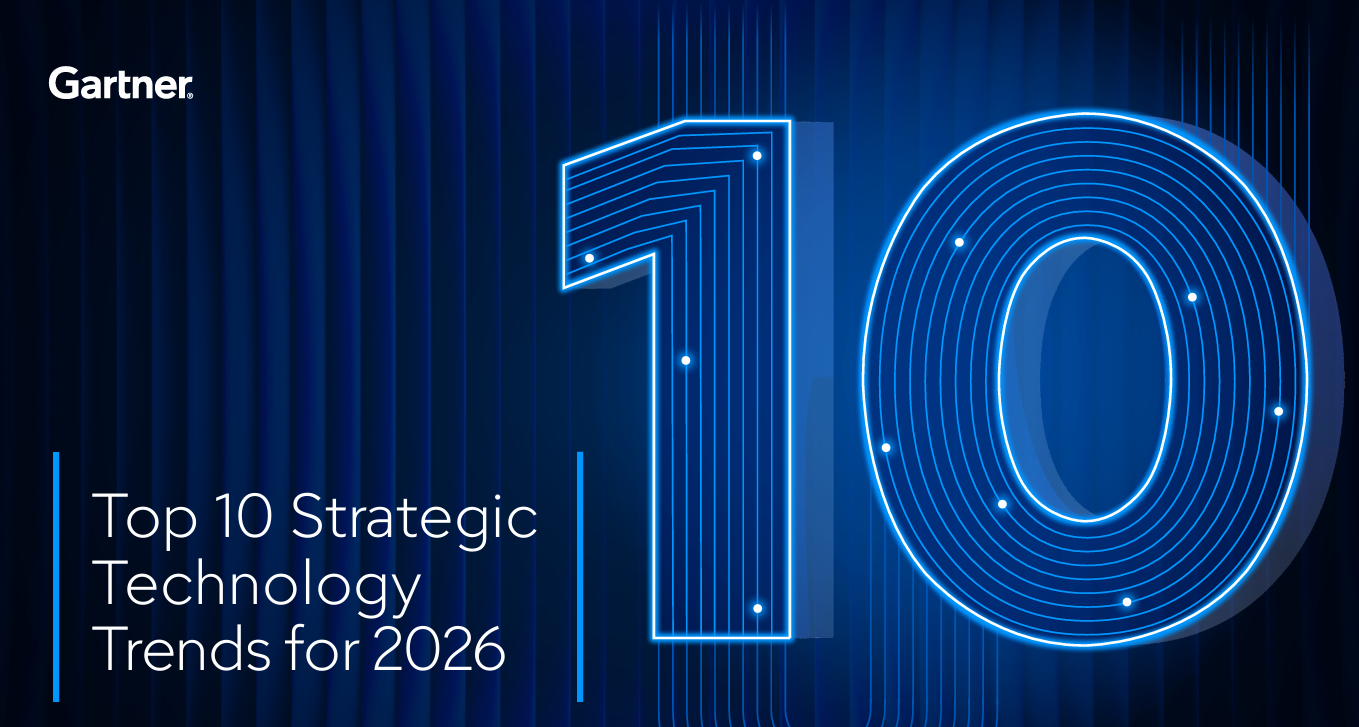
When technology ceases to be a mere instrument and begins to think alongside us, the nature of enterprise itself transforms. Gartner’s Top 10 Strategic Technology Trends for 2026 is not a catalogue of emerging tools it is a statement on power, resilience and the shifting anatomy of decision-making. It signals the rise of a cognitive order where data, algorithms and trust no longer support organizations from the outside but define their very pulse.
This is not a list for CIOs to mechanically implement. It is a framework for leadership in an age when computation determines credibility, and where architecture choices shape governance itself. The design of an AI model can now tilt market behaviour; the geography of your data can redraw your jurisdiction; the quality of your compute can decide your competitiveness.
Taken together, these ten trends do not just predict the future they demand preparation for it. They mark the moment when technology evolves from an operational enabler to a strategic conscience, and when leadership must learn to think, decide and act at the speed of intelligence itself.
The Architect: Building AI-Native Foundations
The first triad AI-native development platforms, AI supercomputing and confidential computing defines how enterprises will build and secure intelligence from the ground up.
1. AI-native development platforms build with intelligence, not bolt it on
The old world of coding is fading. AI-native development replaces lines of code with orchestration where humans design intent and models generate, test, and iterate code autonomously.
By 2030, Gartner predicts that 80% of development teams will operate as “AI-augmented pods,” shrinking delivery time and expanding creative bandwidth.
For leaders, this means redefining what productivity looks like: smaller, faster and far more intelligent. This trend helps CIOs address backlogs and shift the “build vs. buy” equation toward building.
Action point: Create multidisciplinary “AI pods” with governance playbooks.
2. AI supercomputing compute as a competitive weapon
Intelligence has become capital. AI supercomputing is the industrial backbone of cognition bringing GPUs, specialized accelerators, and quantum-ready fabrics into everyday enterprise architecture.
Control over compute means control over innovation cycles. As generative AI models evolve, those who own or efficiently lease high-performance compute will reduce cost and dependency on hyperscalers.
Action point: Conduct a compute audit. Identify workloads that need sovereign or hybrid setups to avoid cloud lock-ins and regulatory exposure.
3. Confidential computing protecting data in use
Encryption used to mean “at rest” or “in transit.” Confidential computing now encrypts data while it’s being used.
This is the bridge between privacy and productivity, critical in sectors like banking, healthcare, and public infrastructure where AI often processes sensitive datasets.
Action point: Pilot enclave-based systems that protect data during AI inference.
Confidential computing isn’t just a compliance tool it’s the next trust dividend.
The Synthesist: When Machines Collaborate and Domains Specialize
If The Architect builds the brain, The Synthesist connects the neurons.
The next triad multiagent systems, domain-specific language models (DSLMs) and physical AI marks a shift from isolated automation to collective cognition.
4. Multiagent systems orchestration beyond automation
Tomorrow’s automation won’t be about one chatbot it’ll be about thousands of specialized agents working together: one negotiating contracts, another monitoring compliance, a third optimizing logistics in real time.
These “agent swarms” will perform as digital teams, learning from feedback and self-adjusting goals.
Action point: Identify cross-functional workflows (like procure-to-pay or claims processing) and experiment with multiagent orchestration. Maintain clear human-in-the-loop escalation points.
5. Domain-specific language models (DSLMs) smaller, sharper, smarter
If 2023 was the year of “big” AI, 2026 will belong to specific AI.
DSLMs AI models trained on domain data such as BFSI, manufacturing, or law deliver precision, compliance and contextual intelligence far beyond general-purpose LLMs.
Action point: Build DSLM pilots for one high-impact task (like fraud detection or legal review). Domain depth will outperform model size.
6. Physical AI intelligence that moves
AI is stepping out of the screen and into the real world into robots, autonomous drones, and self-managing warehouses.
“Physical AI” makes decision-making tangible, driving real-world efficiency and also real-world risk. As machines gain agency, ethics, safety, and liability will follow closely behind.
Action point: Map which digital decisions already translate into physical actions. Build shut-off protocols and predictive maintenance powered by AI to prevent accidents before they occur.
The Vanguard: Trust as the New Operating System
Where innovation scales, risk compounds.
The final triad, pre-emptive cybersecurity, digital provenance, AI security platforms and geopatriation signals a decisive shift from defense to anticipation and from dependence to sovereignty.
7. Preemptive cybersecurity predict before you patch
Detection is too late. The next era of cybersecurity focuses on anticipation: using predictive analytics, attack simulations and behavioural telemetry to detect anomalies before breaches occur.
Action point: Broaden telemetry across cloud, APIs, and partner systems. Build a “pre-emptive detection centre” powered by AI models that learn threat patterns in advance.
8. Digital provenance tracing truth in a world of fakes
In an economy where deepfakes, synthetic media, and data tampering are rampant, provenance becomes the anchor of truth.
Every dataset, model, and output must carry a verifiable chain of custody to remain trustworthy.
Action point: Begin with small pilot’s trace provenance across KYC documents or compliance workflows using blockchain or ledger-based verification.
9. AI security platforms securing the mind of the machine
Today’s security tools guard code: tomorrow’s must guard cognition.
AI security platforms will monitor model integrity, access, bias, and drift securing the “thought process” of intelligent systems.
As AI becomes the new control plane, model-level security will define regulatory compliance.
Action point: Add model validation to CI/CD pipelines, monitor drift, and maintain rollback capabilities for compromised AI models.
10. Geopatriation- the return of digital sovereignty
Perhaps the most geopolitical of all trends, geopatriation refers to bringing data, workloads, and AI models under national or regional control.
It’s the digital twin of economic sovereignty driven by the realization that cloud dependency can be both a technical and strategic risk.
Action point: Map workloads that hold national or customer-sensitive data. Plan for hybrid deployment architectures that comply with India’s emerging data protection and sovereignty frameworks.
Reading Between the Lines: The Shift to Strategic Autonomy
Gartner’s 2026 outlook can be read as a single sentence: enterprises that build strategic autonomy will own the future.
Whether that autonomy comes through AI supercomputing, sovereign cloud, or pre-emptive security, the underlying narrative is consistent trust will trade at a premium.
The implications for India are profound. India’s digital economy anchored by platforms like ONDC; UPI and India Stack already demonstrates that trust-driven infrastructure can scale faster than capital-driven ecosystems.
Now, with emerging AI governance frameworks and domestic compute initiatives, Indian enterprises can build homegrown resilience training DSLMs in local languages, enforcing confidential computing norms, and adopting provenance as a business standard.
Editorial Reflection: Technology as Character, Not Commodity
In 2026, technology is no longer infrastructure its identity. It carries ethics, geopolitics, and purpose. The lines between AI, security, and governance have blurred into one shared narrative: who owns intelligence, and who can be trusted with it?
Gartner’s framework reminds us that the next decade will not belong to those who merely automate, but to those who orchestrate. The leaders who understand the moral and strategic architecture of technology not just its mechanics will shape the world’s next operating system.