






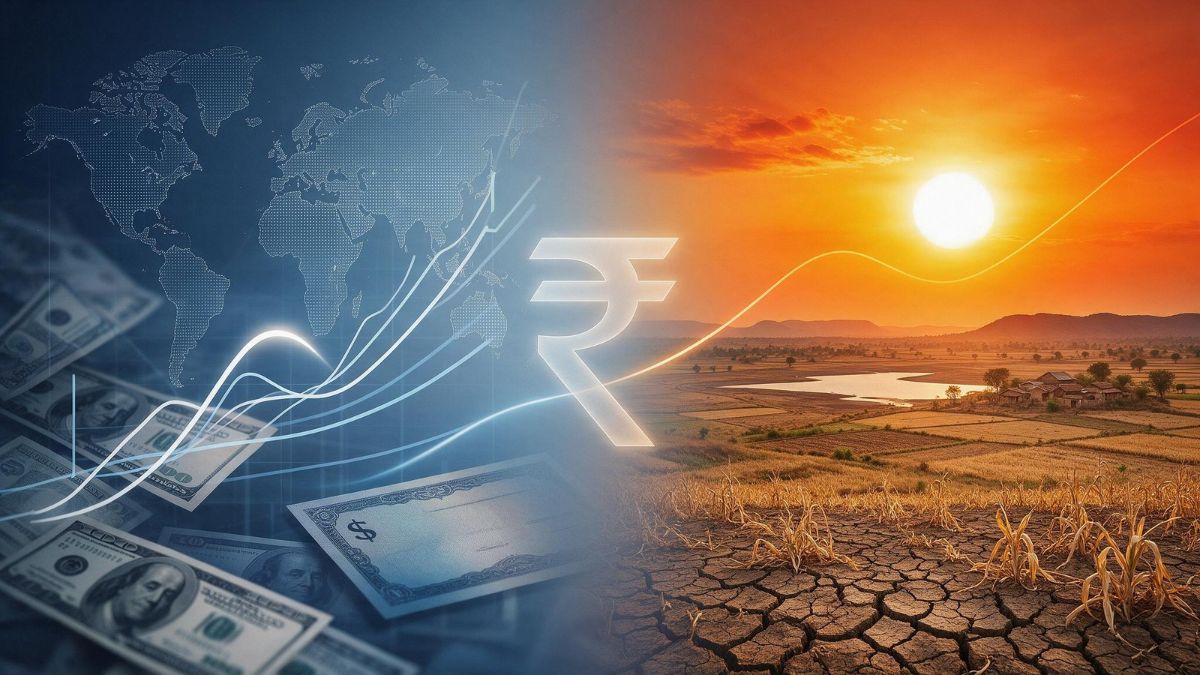
India’s financial outlook in 2026 is being shaped by two forces that are usually analysed separately: the world’s mounting need to refinance debt and the domestic economic uncertainty associated with El Nino. Together, they create a more consequential risk picture for policymakers, corporates, investors and financial institutions.
One force raises the global price of capital. The other can affect domestic inflation, rural incomes, supply chains and credit performance. Their intersection matters because it narrows the room between external stability and domestic growth. The resulting story is not simply one of foreign portfolio outflows, weak rainfall or a volatile rupee. It is a story about how global financing conditions and physical climate risk can reinforce each other in an import-dependent, capital-seeking economy.
The world is refinancing, not just borrowing
Global debt markets have entered a period in which the recurring need to refinance old liabilities is as important as new borrowing. The OECD projects that its member governments will raise around $18 trillion from bond markets in 2026, following about $17 trillion in 2025. Outstanding OECD sovereign bond debt reached $61 trillion in 2025.
The critical figure is refinancing. OECD sovereign refinancing needs climbed from about $12 trillion in 2024 to $13.5 trillion in 2025 and are projected to reach about $14 trillion in 2026. In practical terms, a large share of annual issuance does not fund a new public project or programme. It rolls over bonds that have matured.
This is normal sovereign-debt-market functioning. Governments routinely replace maturing debt with newly issued debt. The concern is not that refinancing exists; it is that the scale of debt, together with shorter borrowing maturities, requires governments to return to markets repeatedly. The OECD identifies sustained fiscal deficits, rising interest costs, shortening issuance maturities, weaker structural demand for long-term bonds and greater refinancing risk as key pressures in the debt market.
That persistent supply matters globally. The United States, Europe, Japan and other advanced economies are not simply large economies; they are also the world’s biggest and most frequent borrowers. Their bond issuance competes for the same investor savings that emerging markets seek to attract.
The price of safety has risen
The US Treasury market remains the main reference point for global pricing of risk. On September 28, the 10-year Treasury yield stood at 5.18%, while the 30-year yield was near 5.6%, according to U.S. Department of the Treasury. These levels are materially different from the ultra-low-rate environment that prevailed for much of the post-global-financial-crisis period and during the pandemic.
A higher Treasury yield does not automatically make India unattractive. But it changes the comparison an international investor makes. If a US government bond offers a return of about 5%, an investor considering Indian equities or debt must assess whether the additional expected return adequately compensates for currency risk, liquidity conditions, market volatility, sovereign and regulatory risk, and the cost of hedging foreign-exchange exposure.
The same repricing is visible in Japan. On September 24, the 10-year Japanese government bond yield rose 10 basis points to 3.075%, its highest level since August 1996, Reuters reported. Japan had long been associated with unusually low domestic yields and was an important source of capital seeking returns abroad. A sustained rise in Japanese yields changes the opportunity cost for Japanese investors considering overseas assets.
The broader point is that India is competing for capital in a world where government bonds in some of the largest developed economies offer more meaningful returns than they did for years. The hurdle rate for emerging-market assets is therefore higher even if India’s long-term growth outlook remains intact.
The rupee is the transmission mechanism
India does not directly finance the debt of the United States, Japan or Europe. But global capital markets connect the cost of their borrowing with the price India pays for capital. That connection is clearest in the currency market.
On September 29, the rupee opened at ₹96.05 against the US dollar and fell to ₹96.13 in early trade, down 16 paise from the previous close of ₹95.97. The currency has been pressured by elevated crude oil prices, persistent foreign fund outflows and higher US Treasury yields.
The exchange rate is shaped by more than overseas bond yields. Oil prices, geopolitical developments, importer hedging, portfolio flows, trade balances, domestic inflation expectations and Reserve Bank of India intervention all matter. Reuters noted that elevated oil prices connected to conflict in the Middle East had the potential to widen India’s import bill and weigh on the rupee.
Yet global interest rates establish the background against which these pressures operate. When US or other developed-market bonds offer higher yields, the attraction of emerging-market risk can decline at the margin. A slower pace of foreign inflows, or outright portfolio outflows, can add pressure to the rupee. Currency depreciation then reduces the dollar value of returns earned on Indian assets, unless investors hedge, which itself carries a cost.
This is the feedback loop: higher global yields raise the required return on Indian assets; weaker portfolio flows can pressure the currency; a weaker currency raises the foreign-currency return needed to attract incremental capital. The result can be higher risk premia even when domestic fundamentals have not deteriorated sharply.
The RBI’s recent liquidity actions show that the external environment and domestic money-market conditions are closely linked. Reuters reported that the central bank sold shorter-duration bonds worth ₹500 billion in the previous week, its first net sale through an auction since November 2017, and planned further ₹250 billion sales to withdraw liquidity on a more durable basis. Earlier in September, banking-system liquidity had risen above ₹10 trillion for the first time, while the RBI used reverse-repo operations, open-market sales and dollar-rupee swaps to manage the surplus.
El Nino adds a domestic layer
The 2026 monsoon outlook introduces a separate, domestic source of uncertainty. India’s Ministry of Earth Sciences projected southwest monsoon rainfall at 90% of the long-period average, with a model error of ±4%. The forecast assigned a 60% probability to deficient rainfall and a further 24% probability to below-normal rainfall an 84% combined probability of a below-normal or deficient monsoon.
El Nino conditions in the equatorial Pacific are expected to strengthen, according to the India Meteorological Department’s extended-range assessment. However, the commercial risk does not lie only in the all-India rainfall number. It lies in the distribution of rainfall across regions and weeks, the dependence of particular districts on rain-fed agriculture, irrigation access, groundwater conditions, crop calendars and the timing of sowing.
A 90% national rainfall forecast can therefore coexist with severe local stress. Some districts may experience delayed sowing or water scarcity, while others face heavy rainfall, local flooding or crop damage. For risk functions, the relevant question is often not whether India’s monsoon is “normal” or “deficient” as a whole, but which local supply chains, borrower clusters, production zones and consumption markets are exposed.
From weather shock to balance-sheet stress
El Nino does not affect corporate and financial-sector risk in a straight line. It travels through a sequence of physical, commercial and financial effects.
A weak or badly distributed monsoon can delay sowing, lower yields, affect crop quality and reduce water availability. Those physical effects can alter demand for fertilisers, seeds and farm equipment; reduce rural spending; interrupt agro processing; disrupt transport; and delay payments across regional distribution networks. The eventual consequences can appear in company revenues, operating margins, inventory values, trade receivables, insurance claims, loan repayment and collateral quality.
The time lag is important. A rainfall shortfall may be visible during a monsoon month, but financial stress can appear later: when a harvest is sold, when distributors struggle to clear inventory, when rural consumption slows, or when loan instalments fall due. This makes El Nino less a one-season agricultural headline than a multi-quarter cash-flow and counterparty-risk event.
Its impact also extends beyond agriculture. Food and beverage companies, consumer-goods firms, textile and cotton processors, agri-input manufacturers, commodity traders, transporters, cold-chain operators and rural retailers can all be exposed to changes in farm output, commodity prices or rural demand. Infrastructure risks may emerge through water shortages, damage to roads and warehouses, logistics interruption, or lower hydropower generation.
Fertiliser shows the compound-risk problem
Fertiliser markets illustrate why climate events cannot be interpreted through a single variable such as agricultural demand. A weaker monsoon does not necessarily produce an equivalent fall in fertiliser use. Farmers may change crop choices, alter the timing of application, rely on irrigation where possible or maintain input use in an effort to protect output. S&P Global has noted that a strong El Nino could affect regional crop production differently while fertilizer demand can remain more resilient than simple yield projections might suggest.
The greater uncertainty can arise from the supply side. Fertiliser pricing is influenced by natural-gas markets, ammonia and urea supply, freight costs, shipping routes, export restrictions and geopolitical tensions. El Nino can add to that volatility by changing planting schedules, crop choices and trade flows across producing countries.
In India, the fiscal dimension is also relevant. Subsidies can cushion farmers from an immediate pass-through of higher global fertiliser prices but can transfer part of the burden to public finances. That means the same shock can be distributed across farmers, input companies, importers, the government and ultimately the broader fiscal environment.
Credit risk is wider than farm loans
The direct relationship between a weak monsoon and agricultural credit stress is well understood. But the greater financial-system question lies in correlation. A climate shock can weaken repayment capacity simultaneously across borrowers that appear distinct in a portfolio: farmers, fertiliser dealers, tractor-finance customers, rural retailers, small transporters, commodity traders, micro-enterprises and consumer-finance borrowers.
This matters because diversification by loan product does not necessarily equal diversification by economic driver. Multiple products can depend on the same district-level agricultural economy. A weak harvest can reduce local cash generation across an entire ecosystem, showing up as slower collections, higher restructuring requests, weaker collateral values and later-stage provisioning pressure.
The risk is particularly relevant when the domestic climate shock coincides with expensive global capital. A weaker monsoon can raise food-inflation concerns and dampen rural income growth. Meanwhile, a softer rupee can raise the domestic cost of imported oil, fertilisers and other commodities. If global yields stay high, external financing conditions remain restrictive. The result is not a predetermined crisis, but a more complex policy and risk environment.
The convergence to watch
The significance of 2026 lies in the convergence of global refinancing pressure and local physical risk. The OECD’s $14 trillion projected sovereign refinancing requirement for 2026 captures the scale of the external capital-demand cycle. India’s 90% monsoon forecast and 84% combined probability of below-normal or deficient rainfall capture the domestic climate uncertainty.
Neither data point alone determines India’s outcome. India retains a substantial domestic savings base, increasingly deep capital markets, significant foreign-exchange buffers, and long-run growth drivers. Nor does El Nino guarantee a uniform agricultural downturn; weather impacts are regional, crop-specific and shaped by irrigation, storage, procurement and local conditions.
But together, these developments highlight a central feature of modern risk: physical climate events and financial-market conditions do not remain in separate compartments. A change in Pacific weather patterns can influence food prices, rural incomes, corporate receivables and bank portfolios. A rise in yields in Washington or Tokyo can influence capital flows, currency expectations and borrowing costs in Mumbai.
For policymakers, corporates, financial institutions and investors, the relevant story is therefore not one of isolated shocks. It is the transmission between them: from global bond issuance to yields, from yields to the rupee, from rainfall to rural cash flows, and from both to the balance sheets that underpin India’s economy.