

As logistics networks become more connected, the distinction between a technology failure and a physical supply-chain crisis is disappearing. Indian businesses may be underestimating the consequences.
For decades, supply-chain risk was largely understood through the physical world: delayed shipments, damaged cargo, labour disruptions, port congestion and unreliable suppliers.
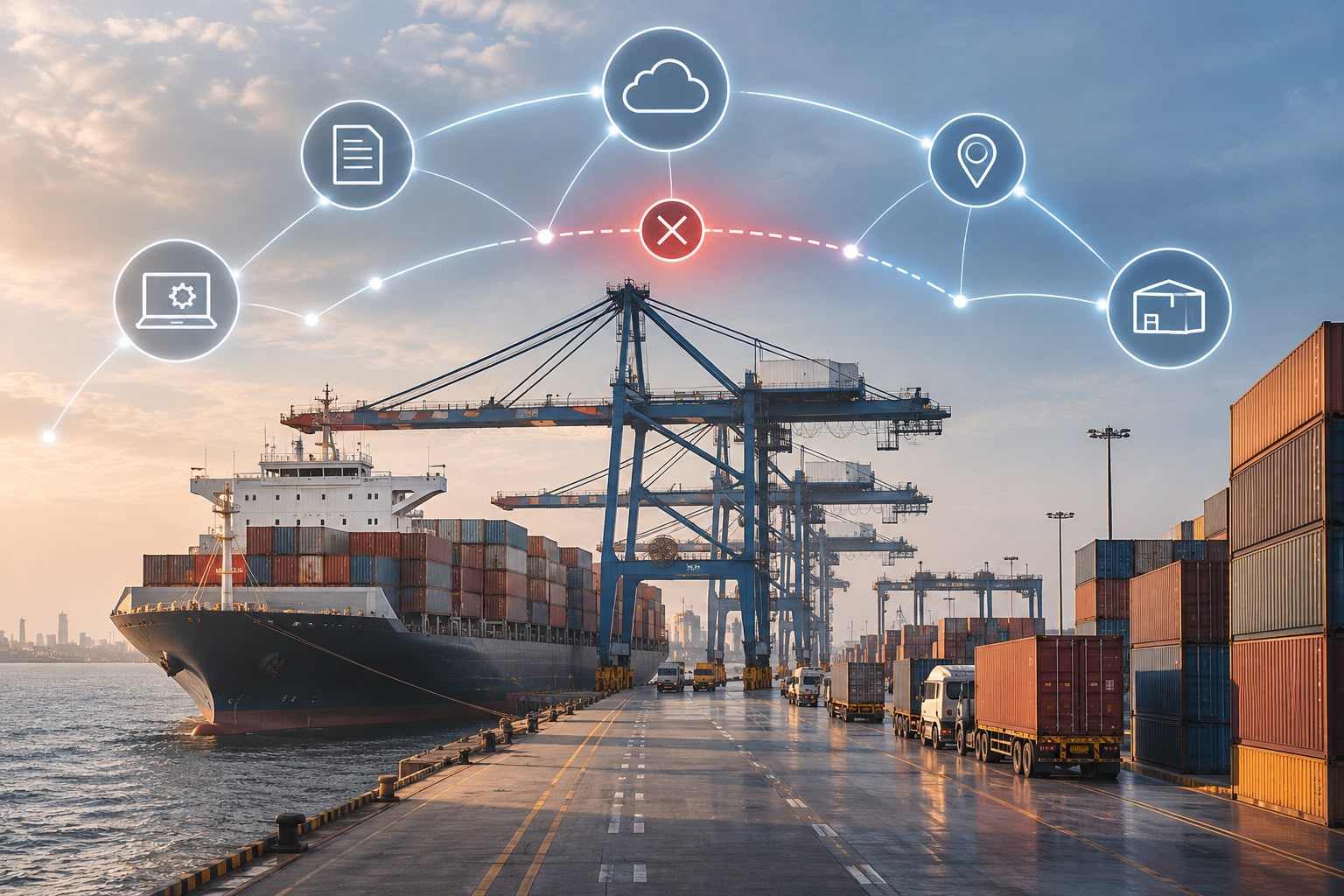
That distinction is becoming obsolete. A container can be physically intact but commercially inaccessible because a terminal’s operating system has failed. A shipment can reach its destination but remain undeliverable because electronic documentation cannot be processed. A manufacturer can have adequate inventory at a port yet face production disruption because its logistics provider has lost operational visibility.
Increasingly, goods do not move simply because infrastructure exists. They move because digital systems permit them to. For India’s manufacturing, trading and logistics enterprises, this creates a new operational-risk equation.
When a cyberattack becomes a logistics crisis
India has already experienced the consequences.
In June 2017, the global NotPetya cyberattack disrupted Maersk’s operations, including those at its terminal within Jawaharlal Nehru Port near Mumbai. The consequences extended beyond disabled computers. Container movements were interrupted, cargo began accumulating and authorities had to coordinate alternative parking arrangements, container freight stations and traffic management measures.
The episode demonstrated how a technology failure originating within an international logistics operator could rapidly become a local infrastructure problem. Nearly a decade later, the underlying vulnerability has become more consequential.
Ports, freight forwarders, transport operators, warehouses and manufacturers increasingly depend on interconnected platforms for documentation, cargo visibility, scheduling, payments and inventory management. The efficiency gains are considerable. So is the potential for disruption to travel across organisational boundaries.
The invisible concentration of risk
Indian businesses routinely assess the reliability of suppliers, transporters and logistics partners.
Far fewer examine whether apparently independent providers rely on the same underlying technology infrastructure. Two freight forwarders may use a common software platform. Multiple warehouses may depend on one cloud provider. Several transport operators may rely on the same tracking or communications infrastructure.
Commercial diversification does not necessarily produce technological diversification. This creates an uncomfortable possibility: a company may believe it has reduced supply-chain concentration risk while unknowingly preserving a common point of failure.
The relevant question is therefore not simply how many logistics partners an enterprise employs, but how independently those partners can continue operating when critical systems become unavailable.
Operational risk is moving beyond the enterprise
Traditional risk management assigns responsibilities within organisational boundaries.
The IT department manages technology. Procurement oversees suppliers. Logistics manages transportation. Finance monitors working capital. Insurance transfers selected losses. But supply-chain disruption rarely respects these divisions.
Consider an exporter whose cargo is stranded because a third-party logistics platform becomes unavailable. The technology failure belongs to the service provider. The shipment delay affects the exporter. The contractual consequences may involve an overseas buyer. Additional costs could arise from storage, demurrage or missed delivery commitments.
Responsibility is fragmented while the commercial loss remains concentrated. This is why supply-chain resilience cannot remain exclusively a procurement or technology function. It requires coordinated oversight involving operations, finance, technology, risk management and senior leadership.
The working-capital consequences
For Indian SMEs, logistics disruption can be particularly damaging because operational delays rapidly become financial constraints. A delayed shipment can postpone invoicing or payment collection. Production schedules may be interrupted while fixed expenses continue. Additional inventory or alternative transportation can absorb scarce liquidity.
For export-oriented manufacturers, unreliable delivery performance can also undermine customer confidence in highly competitive international markets. The financial consequences may persist long after the original technology problem has been resolved. This suggests that conventional business-continuity planning, often focused on restoring internal systems, is insufficient.
Enterprises must understand how long they can withstand the unavailability of external logistics services without compromising cash flow, customer commitments or production continuity.
Resilience cannot be outsourced
India’s logistics modernisation is essential to improving competitiveness. Digital platforms, automated terminals, connected warehouses and integrated freight systems can reduce friction across supply chains.
But technological sophistication should not be confused with operational resilience. Boards and promoters need to ask whether critical logistics dependencies have been identified, whether alternative arrangements can function during technology outages and whether contractual protections adequately reflect potential losses.
They must also distinguish between possessing insurance and understanding precisely which disruptions their policies cover. Most importantly, contingency arrangements should be tested under realistic conditions rather than assumed to work.
A backup transporter is of limited value if it depends on the same failed platform. An alternative warehouse provides little protection if inventory records are inaccessible.
The next competitive advantage
India’s ambitions to become a major global manufacturing and export hub depend on more than production capacity, infrastructure investment and logistics efficiency. They depend on reliability. International customers increasingly evaluate suppliers not merely on price and quality, but on their ability to deliver consistently amid disruption.
For Indian enterprises, operational resilience must therefore become a source of competitive differentiation rather than an administrative compliance exercise. The companies best prepared for future supply-chain shocks may not be those with the most sophisticated digital systems. They may be those that understand exactly what happens when those systems stop working.
The next supply-chain crisis may begin not with a ship stranded at sea, but with a system failure that prevents thousands of perfectly serviceable shipments from moving.