

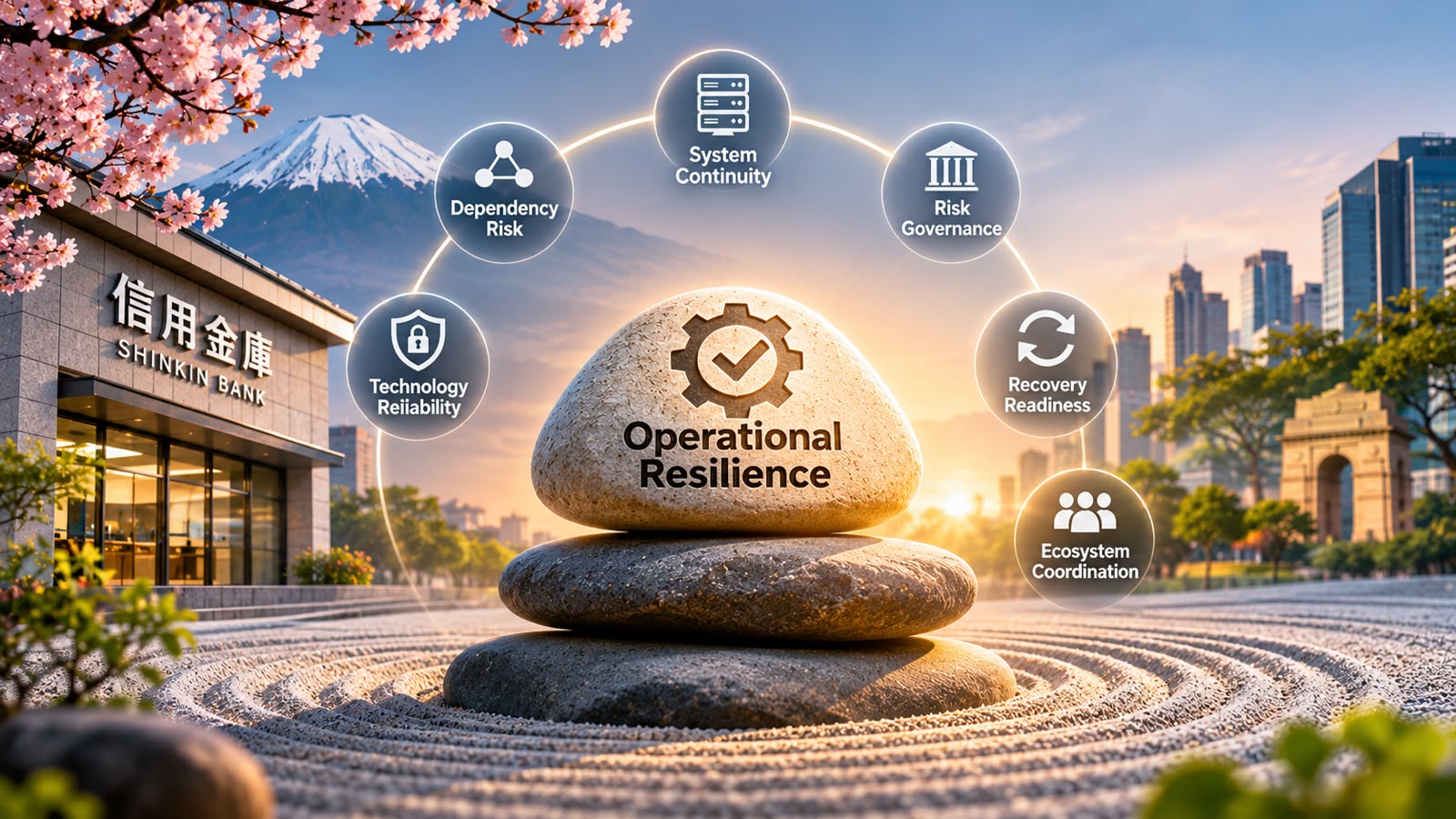
An equipment malfunction affecting 128 Japanese financial institutions offers an important lesson for India’s banking ecosystem: operational resilience increasingly depends on understanding risks beyond institutional boundaries.
On November 6, a technology malfunction in Japan disrupted banking operations across 128 cooperative financial institutions. For nearly six hours, customers experienced interruptions to branch transactions, ATM services and other banking operations.
The cause was neither a cyberattack nor a malicious intrusion. It was an equipment failure within shared banking infrastructure operated by the Shinkin Kyodo Center. Services were restored that evening. Yet the incident offers a valuable opportunity for banking institutions and regulators elsewhere to examine an increasingly consequential dimension of financial stability: the concentration of operational dependencies within interconnected financial systems.
For India, whose digital financial infrastructure has transformed the delivery of banking and payment services, the lessons are particularly relevant.
The paradox of shared infrastructure
Modern banking depends on technological interdependence. Core banking platforms, payment networks, cloud infrastructure, authentication systems and outsourced technology services enable institutions to operate efficiently while delivering increasingly sophisticated customer experiences.
These arrangements create economies of scale. They can also concentrate operational dependencies.
Japan’s Shinkin Joint System supports 236 cooperative financial institutions through shared infrastructure. When equipment malfunctioned at its western operating centre, 128 otherwise independent institutions experienced simultaneous disruption.
The distinction is between institutional independence and operational independence.
Banks may maintain separate balance sheets, governance structures and risk committees while depending on common technological infrastructure. Their financial risks remain institution-specific. Their operational vulnerabilities may not.
This distinction is becoming increasingly important as financial institutions pursue greater technological integration.
India’s digital success creates a new resilience imperative
India’s digital payments transformation has been extraordinary. According to the Reserve Bank of India’s April 2026 discussion paper on digital payment safeguards, transaction volumes expanded 38-fold over the preceding decade, while transaction values more than tripled.
This growth reflects significant progress in financial inclusion, interoperability, convenience and technological innovation. It also raises the importance of ensuring uninterrupted availability of essential financial services.
India’s banking and payments ecosystem encompasses banks, payment system operators, telecommunications networks, cloud platforms and numerous third-party technology providers. These relationships create considerable efficiencies. They also make it important to understand how disruption within one critical component could affect services across institutional boundaries.
The Japanese incident does not suggest that India’s financial infrastructure shares the same vulnerabilities. Rather, it demonstrates why resilience assessments must increasingly consider the wider ecosystem alongside individual institutions.
Why cybersecurity alone cannot ensure operational resilience
Cybersecurity has rightly become a major priority for financial institutions. Yet Japan’s experience illustrates why cybersecurity preparedness and operational resilience, although closely related, are not interchangeable.
Sophisticated threat detection, encryption and access controls are essential. But they cannot, by themselves, eliminate the consequences of equipment malfunction, network disruption, unsuccessful system changes or infrastructure dependencies. For customers, the underlying cause of an interruption is often less important than its consequences.
The relevant measure of resilience is not simply an institution’s ability to prevent incidents, but its capacity to maintain critical services, contain disruption and restore operations within acceptable limits.
This requires a broader approach that brings technology, risk management, business continuity and customer outcomes into a common framework.
From regulatory frameworks to operational readiness
India’s regulatory framework already provides an important foundation for addressing these challenges. The RBI’s 2023 directions on information technology governance and outsourcing establish expectations concerning technology controls, business continuity, third-party risk management and institutional accountability.
Its guidance on operational risk management and operational resilience, originally issued in April 2024 and subsequently updated, further recognises the importance of interconnections and interdependencies within the financial system.
The framework emphasises three complementary priorities: preparing and protecting institutions, building resilience, and learning and adapting. The next opportunity lies in translating these principles into increasingly comprehensive assessments of shared infrastructure, technology concentration and recovery capabilities.
A successful disaster-recovery exercise within an individual bank may not fully demonstrate resilience when several institutions simultaneously depend on a disrupted external service. Similarly, contractual assurances from technology providers are valuable, but their effectiveness ultimately depends on recovery capabilities demonstrated under realistic stress conditions.
Greater visibility into critical dependencies, including those within vendors’ own supply chains, can strengthen both institutional preparedness and system-wide resilience.
Three priorities for banking boards
Japan’s experience offers three useful questions for Indian banking boards and senior management:
- Visibility: Do institutions have sufficient visibility into the shared infrastructure and external dependencies supporting their most critical customer services?
- Scenario testing: Do business continuity and resilience exercises adequately consider simultaneous disruptions involving technology providers, payment networks and interconnected institutions?
- Customer outcomes: Are recovery capabilities evaluated against actual customer outcomes and service continuity, alongside conventional technical restoration targets?
These are questions of governance as much as technology management.
Effective operational resilience requires coordinated accountability across CROs, CIOs, CISOs, business leaders, technology partners and boards.
The next frontier of banking trust
Japan’s disruption was temporary and did not constitute a banking solvency crisis. Its significance lies in demonstrating how an ordinary equipment malfunction can have consequences across multiple financial institutions.
For India, this is not a question of questioning the strength of its digital banking architecture, but of reinforcing the foundations that have enabled its remarkable expansion.
India’s financial institutions have become exceptionally effective at making money move faster. The next frontier is ensuring that essential financial services remain equally dependable when the infrastructure supporting that speed encounters disruption.
The measure of a mature digital financial system is not merely how efficiently it operates under normal conditions, but how reliably it serves its customers when conditions are anything but normal.