




The future of motor insurance is being rewritten at the intersection of mobility, artificial intelligence, climate volatility and changing customer expectations. The traditional model of insuring a vehicle is gradually giving way to a far more sophisticated responsibility: understanding human behaviour, predicting emerging risks and creating a resilient mobility ecosystem.
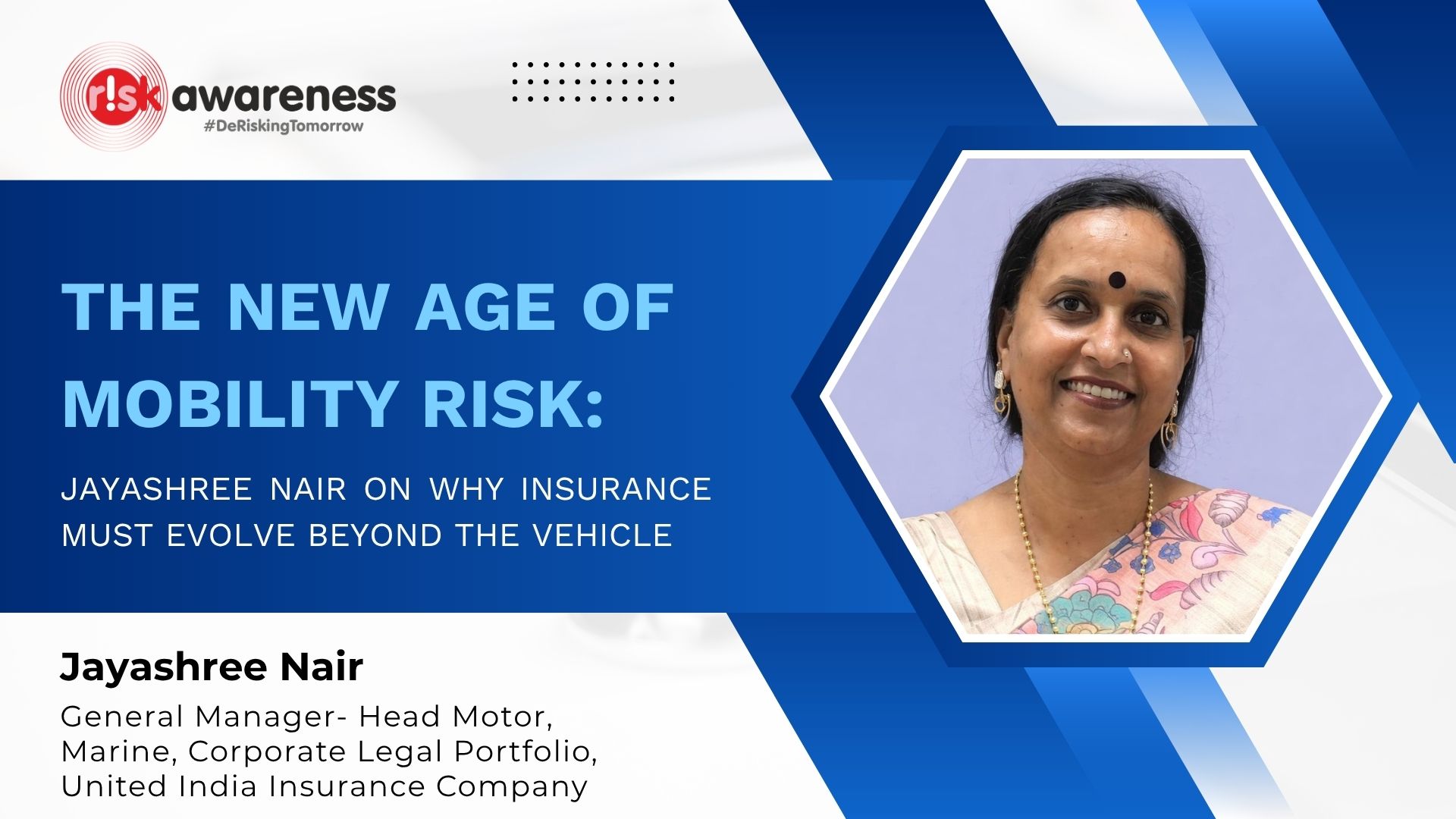
Few leaders have witnessed this evolution as closely as Jayashree Nair, General Manager at United India Insurance Company Limited. With extensive experience across underwriting, claims management, operations and portfolio leadership, Nair brings a uniquely balanced perspective shaped by both the commercial realities and the social purpose of insurance.
Her leadership philosophy has been forged by decades of understanding a fundamental truth of the insurance business: growth that compromises discipline ultimately weakens the very promise that insurers make to their customers.
“In insurance, discipline and sustainability are more important than short-term growth,” she says.
This philosophy assumes even greater relevance today as the motor insurance industry enters one of the most transformative phases in its history. The emergence of electric vehicles, connected cars, advanced driver assistance systems, telematics and usage-based insurance is changing the very definition of risk.
“Motor insurance is no longer only about vehicles; it is about mobility, technology and data,” Nair observes.
For insurers, this transition demands a complete rethinking of underwriting models. Historical loss patterns and conventional rating parameters are increasingly being complemented by real-time data, predictive analytics and technology-enabled insights.
According to Nair, the winners in the next era of insurance will not be those who simply digitise existing processes, but those that fundamentally reimagine how risk is identified, priced and managed.
“Data will define underwriting and technology will define customer experience in the future of insurance,” she explains.
Yet, even as technology reshapes the industry, Nair believes the core principles of insurance remain unchanged: trust, fairness and the ability to stand by customers during their moments of vulnerability.
As one of India’s leading public sector general insurers, United India Insurance carries a responsibility that extends beyond market share and profitability. It plays an important role in ensuring insurance accessibility, maintaining underwriting discipline and supporting stability across the wider insurance ecosystem.
“Public sector insurers do not just participate in the market; they help stabilise the market,” she says.
The challenges ahead, however, are becoming increasingly complex. Rising repair costs driven by technologically advanced vehicles, growing litigation, inflationary pressures in claims, fraudulent activities and climate-induced events such as floods and cyclones are fundamentally changing the economics of motor insurance.
For Nair, the industry’s long-term resilience will depend on stronger fraud detection frameworks, smarter claims analytics, better repair ecosystem partnerships and a more data-driven approach to risk assessment.
“The future of motor insurance will depend on how well we manage claims costs and fraud,” she notes.
She also believes that innovation in insurance cannot be limited to products and technology alone. As policies become more customised and sophisticated, customer awareness and financial literacy must evolve alongside them.
“Customer education is as important as product innovation in insurance,” Nair emphasises.
For the next generation of insurance professionals, her message is equally clear. The future belongs to those who combine traditional insurance fundamentals with digital capabilities, analytical thinking and an unwavering commitment to ethics.
“Insurance is a business of trust, discipline and long-term commitment.”
As India advances towards its vision of Insurance for All by 2047, the role of insurers will expand far beyond risk transfer. They will become data-driven custodians of resilience in an increasingly uncertain world.
Leaders like Jayashree Nair represent this transition, combining the prudence of traditional underwriting with the possibilities of technology-led transformation. In the future of mobility, the most successful insurers may not simply be those that pay claims fastest, but those that understand risk deepest.