





RBI’s 2024-25 Trends Report: A Forward-Looking Risk Playbook for Corporate India

As India’s banking and non-banking system enters 2026, headline metrics suggest robustness. Yet the Reserve Bank of India’s latest “Report on Trend and Progress of Banking in India 2024-25” reads less like a performance review and more like a strategic risk playbook for corporate treasuries and BFSI leadership. Growth, digitisation and financial inclusion are reframed…

Read More

Real-Time Treasury, Real-World Volatility: Why Indian Treasuries Must Rethink Liquidity Risk

Liquidity risk has re-emerged as the defining challenge for corporate treasurers worldwide. In global surveys, it consistently ranks as the No. 1 concern, ahead of FX volatility, cyber incidents and counterparty risk. Elevated interest rates have sharpened the cost of holding excess cash, while vulnerabilities in banking systems across the US, Europe and parts of…

Read More

Asset Tokenisation and India’s Next Financial Leap: Opportunity, Risk and the Need for Guardrails

India’s financial architecture has periodically undergone step-change reforms that quietly but fundamentally altered economic participation. Bank nationalisation expanded credit access. Dematerialisation modernised capital markets. UPI democratised payments at an unprecedented scale. The growing conversation around asset tokenisation suggests the next frontier may lie not in how Indians transact, but in how they own, invest and…

Read More

FX, Rates and a More Volatile Rupee: The New Playbook for Indian Treasury Risk

For much of the decade following the global financial crisis, currency volatility was treated as a manageable background risk rather than a board-level concern. Central banks smoothed extremes, interest rates stayed near historic lows and treasury teams optimised around efficiency rather than resilience. That era has decisively ended. Since 2022, global treasurers have been forced…

Read More

The Year Corporate Fraud Went Digital: How 2025 Rewrote the Risk Playbook

Corporate fraud in 2025 did not merely “move online”. It learned to operate like a digital business process. Fraud schemes increasingly mirrored legitimate workflows, exploiting payment rails, identity systems and insider access with a precision that traditional controls were never designed to detect. What emerged was a new doctrine of misconduct: faster execution, lower visibility…

Read More

Cyber-Linked Liquidity Risk: When Treasury Becomes a Systemic Vulnerability

For much of corporate history, liquidity risk was understood in traditional financial terms. It reflected access to funding, exposure to market volatility or the ability to roll over debt in stressed conditions. Treasury operations, while important, were rarely viewed as sources of systemic fragility. That assumption no longer holds. The shift to real-time payments, digitised…

Read More

Climate, Corridors and Concentration: The Next Decade of Supply Chain Risk for Indian Industry

For much of the past three decades, supply chain risk was treated as an efficiency problem. Optimise sourcing, minimise inventory, compress transit times. Resilience was assumed to follow scale and globalisation. Recent years have dismantled that belief. Across the world, climate volatility, geopolitical realignment and corridor concentration are reshaping how risk manifests in supply chains….

Read More

Cybersecurity as a Test of Corporate Credibility

In discussions on digital resilience, cybersecurity is frequently framed as a technical discipline, the domain of firewalls, encryption protocols, endpoint monitoring and incident response playbooks. Yet the closing argument made by Dr. Alby John Varghese IAS, CEO, Tamil Nadu e-Governance Agency at a recent cybersecurity conference organised by Amanha Idealabs in Chennai, points to a…

Read More

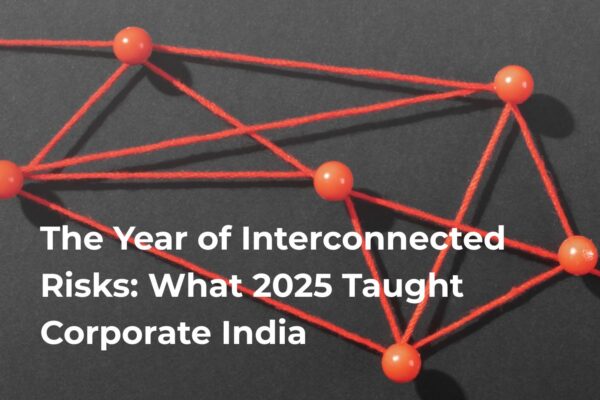
The Rise of Interconnected Risks: Why Every Business Must Rebuild Its Risk Architecture

The contemporary risk landscape has evolved into a dense web of interdependent vulnerabilities rather than a collection of isolated threats. Across large corporates, financial institutions, mid-market entities and MSMEs, the same structural reality holds true: disruptions no longer remain confined to one domain. They spread rapidly across financial systems, supply chains, digital networks and geopolitical…

Read More
Top