


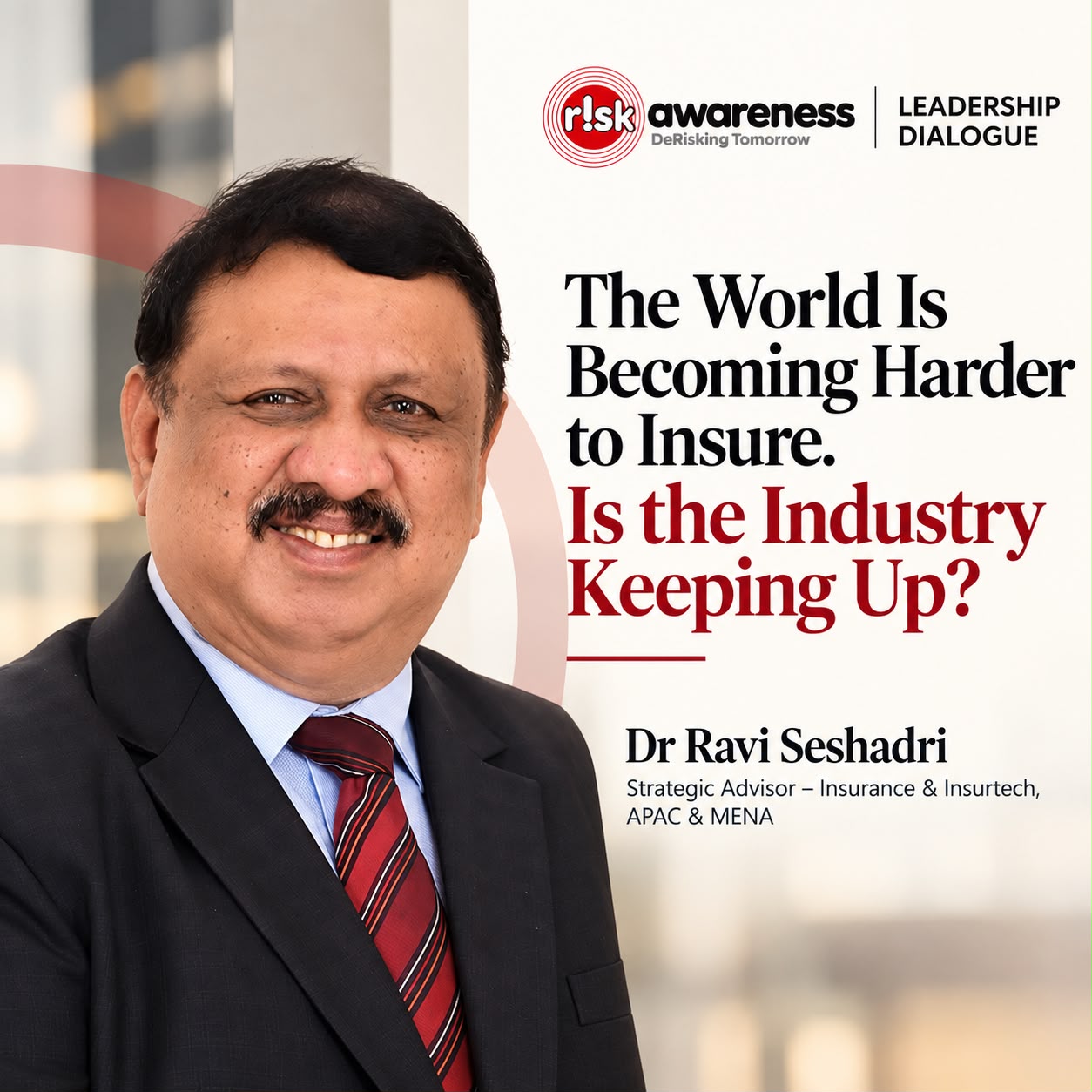
Dr Ravi Seshadri | Strategic Advisor – Insurance & Insurtech, APAC & MENA
Cyber vulnerabilities, artificial intelligence, geopolitical fragmentation and escalating climate losses are challenging the assumptions on which modern insurance was built. In an exclusive interaction with Risk Awareness on the sidelines of an industry conference in Mumbai this week, Dr Ravi Seshadri, Strategic Advisor – Insurance & Insurtech, APAC & MENA, examines whether the insurance industry is adapting quickly enough to these emerging threats, and how insurers must rethink their own resilience, underwriting models and the increasingly delicate balance between commercial sustainability and affordable protection.
Cyber Resilience | Are Insurers Managing Their Own Exposure?
Q. Insurers assess cyber risks for their clients. Are they equally rigorous about their own vulnerabilities?
This is a question the insurance industry must confront with considerable seriousness. Insurers are custodians of sensitive personal, financial and medical information, while their operations increasingly depend on interconnected technology platforms, intermediaries and external service providers.
The exposure is therefore much wider than an isolated cyberattack. A significant breach can disrupt underwriting, claims settlement, distribution and customer servicing simultaneously. More importantly, it can undermine the very trust on which insurance is built.
IBM’s 2026 Cost of a Data Breach Report places the average organisational cost of a breach in India at ₹25.5 crore, up 15.9 per cent from the previous year. The figure is not specific to insurers, but it illustrates the financial consequences of inadequate cyber resilience.
I believe insurers must approach cyber risk as an enterprise-wide governance responsibility rather than a technology function. Independent security assessments, continuous vulnerability management, third-party risk reviews, incident-response simulations and board-level oversight should form part of a comprehensive framework.
Cyber insurance for an insurer’s own exposures can provide an additional financial safeguard, but it cannot substitute for preventive controls and operational resilience.
The real test is not whether an institution can prevent every attack. That is unrealistic. It is whether the organisation can identify a breach quickly, contain the damage, protect policyholders and restore essential services without losing institutional credibility.
An insurer’s ability to protect others must begin with its ability to protect itself.
2. Artificial Intelligence | Can Insurers Still Trust the Evidence?
Q. As AI makes fabricated claims increasingly convincing, how must insurers strengthen their fraud defences?
Insurance has always depended on the credibility of information. Whether it concerns the circumstances of an accident, medical documentation or the valuation of damaged property, the claims process rests on establishing what actually happened.
Generative AI is making that task more complicated.
Synthetic images, altered documents, fabricated invoices and convincing impersonations can potentially be produced at a scale and sophistication that traditional verification processes were never designed to address.
A recent study places artificial intelligence as the second-largest global business risk, rising from tenth position in 2025. This reflects a much broader concern about AI-related operational, legal and reputational exposures.
Insurers will have to strengthen their capabilities through forensic analytics, anomaly detection, document authentication, cross-verification of claims information and more sophisticated fraud intelligence.
However, I would caution against believing that technology alone will resolve the problem. AI-driven detection systems can also produce false positives, potentially delaying genuine claims and penalising honest policyholders.
There must therefore be appropriate human oversight, clearly defined escalation procedures and transparent accountability for automated decisions.
The industry should also explore greater collaboration in fraud intelligence, subject to privacy and competition safeguards. Fraudsters exploit gaps between institutions, while insurers often operate within their own information boundaries.
In my view, the central challenge is to use AI to strengthen trust without allowing automation to weaken fairness.
The objective must be faster and more reliable verification, not merely faster rejection of suspicious claims.
3. Geopolitical Risk | Is Traditional Underwriting Still Adequate?
Q. How should insurers rethink underwriting as geopolitical instability becomes a persistent business risk?
For a considerable period, geopolitical events were often treated as exceptional disruptions. That assumption is becoming increasingly difficult to sustain.
Conflicts, sanctions, trade restrictions and supply-chain fragmentation are now influencing the operating environment of businesses across multiple geographies. Even enterprises with no direct presence in conflict zones may experience significant indirect consequences.
The Allianz Risk Barometer 2026 ranks political risks and violence seventh globally, their highest position in the survey’s history. Business interruption remains the third-largest concern, reflecting the interconnected nature of modern commercial exposures.
For insurers, this demands a more dynamic approach to underwriting.
Traditional models rely heavily on historical claims experience. While that remains essential, historical data alone cannot adequately capture rapidly changing political circumstances, concentrated supply-chain dependencies or the possibility of multiple disruptions occurring together.
Underwriters must increasingly incorporate geopolitical intelligence, scenario analysis, geographic concentration assessments and stress testing into portfolio management.
Equally important is clarity of coverage. War exclusions, political violence, trade credit, marine and business interruption policies respond differently to geopolitical events. Policyholders must understand these distinctions before a loss occurs.
I also believe the industry must pay greater attention to accumulation risk. A single geopolitical event can affect several lines of business simultaneously, creating exposures that may not be evident when individual policies are assessed in isolation.
The answer is not indiscriminate premium increases or wholesale withdrawal from difficult markets. It is more intelligent risk selection, appropriate reinsurance protection and disciplined capital allocation.
In an interconnected world, the greatest underwriting mistake may be to continue treating interconnected risks as independent events.
4. Climate Risk | Will Geography Determine Insurability?
Q. Could worsening climate exposure make some industrial locations increasingly difficult or expensive to insure?
Climate risk is fundamentally changing how insurers must evaluate physical assets.
Historically, underwriting decisions were influenced by location, construction, occupancy, protection standards and past loss experience. These factors remain relevant, but the underlying environmental conditions are no longer necessarily stable.
Flood patterns, extreme rainfall, cyclones, heat stress and other weather-related hazards can alter the risk profile of an industrial facility over time. This is particularly important for manufacturing clusters and logistics infrastructure, where large concentrations of assets may be exposed to a common event.
According to Swiss Re Institute, natural catastrophes generated approximately US$107 billion in insured losses globally during 2025, against economic losses of around US$220 billion. The difference illustrates the continuing scale of uninsured exposure.
For India, the implications deserve serious consideration. Manufacturing facilities are increasingly capital-intensive, while industrial supply chains often depend on a relatively small number of critical locations.
Insurers will need to combine historical loss data with more granular geospatial information, climate projections and assessments of physical resilience.
However, I do not believe the industry’s response should simply be to identify vulnerable locations and withdraw capacity.
Insurance has an important role in encouraging adaptation. Better drainage, flood protection, resilient construction, emergency preparedness and business continuity arrangements can materially influence the severity of losses.
Industrial associations, local authorities and insurers should work together to address vulnerabilities at the cluster level rather than leaving every enterprise to manage them independently.
The future insurability of an industrial location may depend as much on its investment in resilience as on its historical exposure to natural hazards.
5. Climate Risk | Can Accurate Pricing Coexist with Affordability?
Q. How can insurers price escalating climate risks without putting essential protection beyond the reach of SMEs?
This is one of the most difficult questions confronting the insurance industry.
On the one hand, insurers have a responsibility to price risks adequately. Underpricing climate exposure may appear beneficial to policyholders in the short term, but persistent underwriting losses ultimately weaken insurers’ capacity to honour claims and provide sustainable coverage.
On the other hand, substantial premium increases or restrictive coverage conditions can leave smaller enterprises dangerously underinsured.
The consequences extend beyond individual businesses. When a manufacturer or logistics operator suffers a major uninsured loss, the disruption can affect employees, suppliers, lenders and the wider regional economy.
The challenge, therefore, is to distinguish between risks that are inherently difficult to insure and those that can become more manageable through appropriate mitigation.
I believe insurers should increasingly recognise measurable improvements in risk quality. Enterprises that invest in flood protection, stronger construction standards, preventive maintenance and continuity planning should have opportunities to demonstrate reduced vulnerability.
Technology can support more granular pricing, but the benefits must be accessible to smaller businesses rather than confined to large corporations with sophisticated risk management teams.
Industry associations can also play an important role by facilitating collective risk assessments, awareness programmes and access to technical expertise.
Parametric insurance, carefully designed deductibles and risk-sharing arrangements may offer additional solutions for selected exposures. However, such products must be transparent about coverage limitations and the possibility that payouts may not match actual losses.
For particularly severe or systemic exposures, public-private risk-sharing mechanisms may also deserve consideration.
Ultimately, affordable insurance cannot be achieved through pricing alone. It requires reducing the underlying probability and severity of losses.
The most sustainable way to make insurance affordable is to make the insured risk more resilient.