





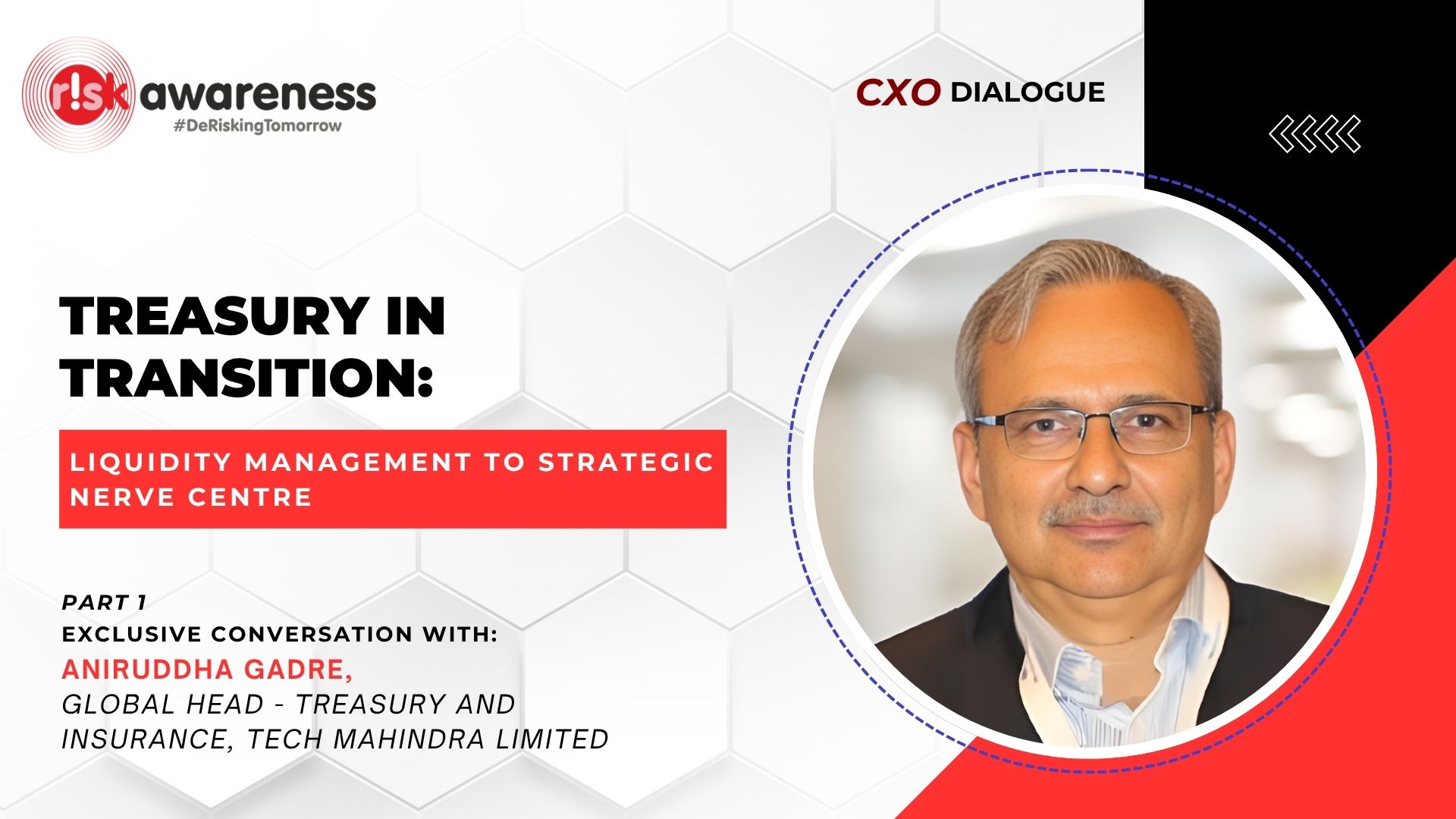
A CXO Dialogue with Aniruddha Gadre, Global Head – Treasury and Insurance, Tech Mahindra Limited.
Treasury is no longer a back-office function confined to cash management and compliance. In a world defined by volatility, fragmentation and rapid technological shifts, it is emerging as a strategic lever for resilience and growth. In the first part of an exclusive 2-part CXO Dialogue conversation with Puru Shah from the RiskAwareness.in team on the state of Corporate Treasury domain in Indian context, Aniruddha Gadre, Global Head -Treasury and Insurance at Tech Mahindra, outlines how the treasury function is being redefined in real time.
The Expanding Mandate of Treasury
Over the last decade, treasury has evolved into a strategic partner to the business. How do you define the “new mandate” of treasury in a globally integrated enterprise?
In today’s interconnected and uncertain environment, the role of global treasury is undergoing a fundamental transformation. It is no longer a purely functional or transactional role, it is increasingly becoming a strategic partner that drives risk intelligence, resilience and digital enablement across the enterprise.
This shift is being shaped by a combination of geopolitical fragmentation, technological disruption and persistent market volatility. Treasury teams are now expected to navigate complexities such as tariffs, sanctions, supply chain disruptions and cross-border regulatory challenges, often in real time.
As a result, the mandate is moving decisively away from a reactive, compliance-driven cost centre to a proactive, digital-first function that enhances business agility and optimizes financial ecosystems.
At a practical level, this evolution is visible across several dimensions. There is a clear move towards centralized liquidity and risk management, often through in-house banking structures that provide real-time visibility across global cash positions and foreign exchange exposures. At the same time, treasury is increasingly leveraging technology to proactively manage counterparty risk, cybersecurity threats and compliance obligations across jurisdictions.
Equally important is the shift towards strategic business partnering. Treasury is now actively involved in informing capital structure decisions, M&A strategies and working capital optimization, areas that were historically outside its core remit. This requires a far deeper integration with business functions, including IT, procurement and operations, enabling a more holistic view of enterprise-wide cash flows and risks.
Technology is acting as a key enabler in this transition. AI and data analytics are no longer optional, they are central to forecasting cash flows, automating processes and generating actionable insights.
The expectation is not just to report data, but to interpret it and support decision-making.
However, this transformation does not happen organically. It requires deliberate investment in talent, systems and governance frameworks. Treasury teams need to build capabilities in data analytics, technology and strategic modelling, while also redefining performance metrics to reflect their contribution to long-term value creation.
Ultimately, the modern treasury function is expected to operate at the intersection of speed, scale and intelligence, combining system-driven efficiencies with human judgement to support business growth in an increasingly complex world.
Managing Currency Volatility in a Fragmented World
With rising geopolitical fragmentation and currency volatility, what are the most critical decisions treasury leaders must get right in managing FX risk, especially for export-driven sectors like IT services?
For the Indian IT services industry, currency risk management remains a central priority, given that a significant portion of revenues is denominated in US dollars. The USD-INR pair, therefore, becomes a critical variable, but it is equally important to track other cross-currency movements such as GBP-USD, EUR-USD and exposures across emerging markets.
What has changed in recent times is the intensity and unpredictability of volatility. The last 12–15 months have been particularly turbulent, driven by geopolitical developments, oil price shocks and shifting global trade dynamics. During this period, the rupee experienced sharp depreciation, underscoring the extent to which global factors now dominate currency movements.
As we move forward in FY27, uncertainty continues to remain elevated. Even in the absence of escalation, persistent geopolitical tensions and fragile risk sentiment are likely to sustain periodic volatility. In such an environment, the traditional approach of static hedging is no longer sufficient.
Treasury teams are therefore recalibrating their strategies along multiple dimensions. The first is a shift towards dynamic and proactive risk management. This includes adopting more flexible hedging strategies, reviewing hedge tenors and volumes more frequently, and aligning currency mixes with evolving exposure profiles.
Second, there is a growing emphasis on regional agility. Given that economic cycles are no longer synchronized globally, centralized models are increasingly being complemented by regional treasury centres (RTCs) that can respond more quickly to localized volatility.
Third, instrument selection is becoming more nuanced. While forward contracts continue to play a role for predictable exposures, options and structured products are being used to retain flexibility and manage uncertainty more effectively.
Another critical area is real-time visibility. Integrating treasury systems with ERP platforms through APIs allows for continuous monitoring of exposures, enabling faster and more informed decision-making. This reduces the lag between market movements and treasury actions.
Perhaps the most important shift, however, is conceptual. Treasury is moving away from attempting to forecast exact currency movements, which is inherently uncertain, to building resilience through scenario planning. By stress-testing business performance under different currency scenarios, organizations can make more robust decisions and protect margins more effectively.
The increasing adoption of AI is further accelerating this transition. From anomaly detection to automated exposure classification and even rule-based execution of hedging strategies, technology is enabling treasury teams to focus more on strategic decision-making rather than operational tasks.
In essence, the objective is no longer to predict volatility, but to build a resilient framework that can withstand it, ensuring that balance sheets, cash flows and profitability remain protected even in highly uncertain conditions.
Disclaimer: Views expressed in the article are the personal opinions of the author and do not reflect the views of Tech Mahindra, its subsidiaries or associated companies.