



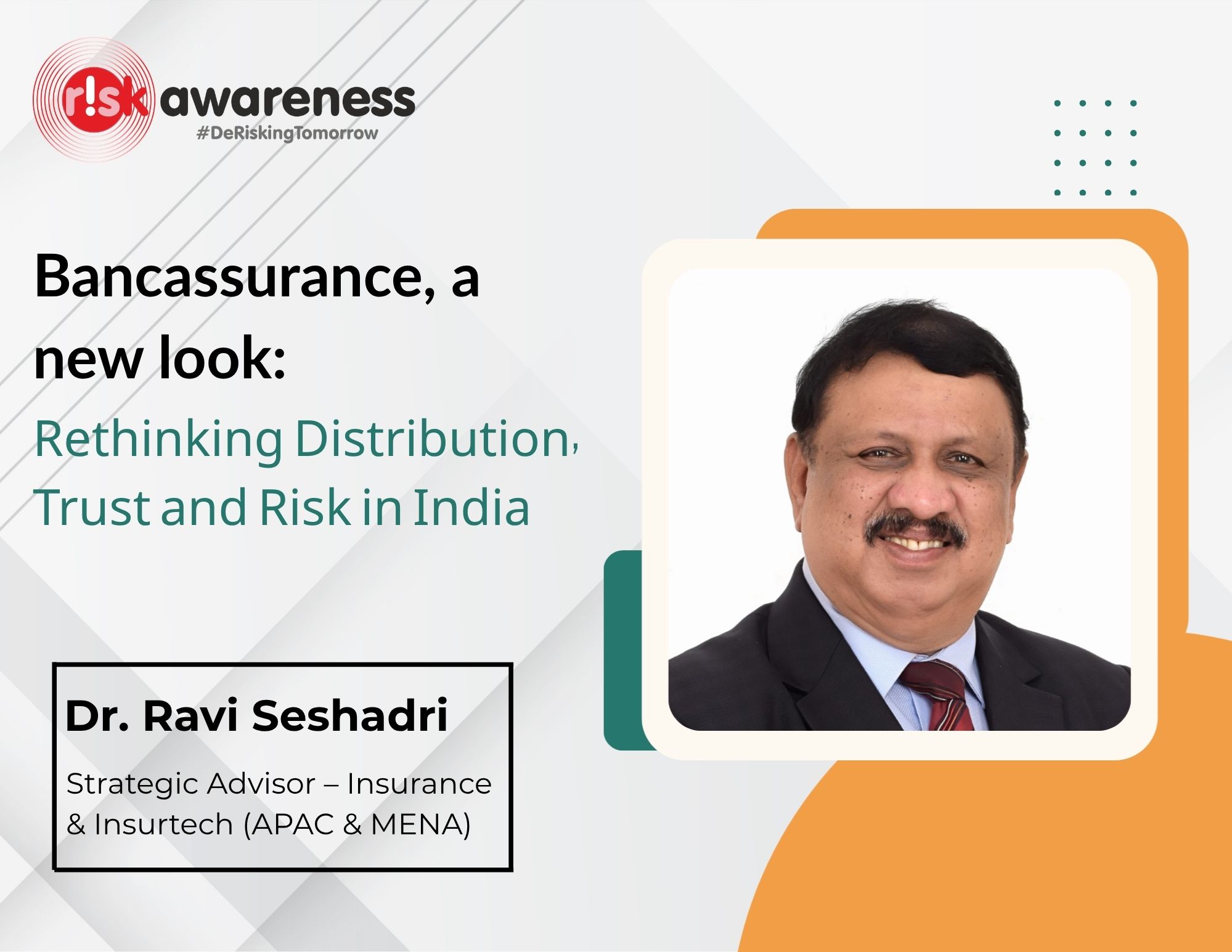
In conversation with Dr. Ravi Seshadri
India’s bancassurance model is entering a decisive phase. Recent signals from the Department of Financial Services (DFS), reinforced by the Finance Minister’s strong stance on mis-selling and the RBI’s tightening regulatory framework, suggest that what was once a high-growth distribution engine is now under structural scrutiny.
In this context, Dr. Ravi Seshadri, insurance industry veteran and board advisor, offers a sharp perspective on whether India is witnessing a temporary correction or a deeper reset.
Q. Bancassurance premiums have doubled over the last five years, clearly signalling deep customer trust and distribution strength. In your view, what structural advantages does bancassurance uniquely offer in India and how can this momentum be leveraged to drive the next phase of insurance penetration, especially in underinsured segments?
Dr. Ravi Seshadri:
The doubling of bancassurance premiums reflects more than distribution efficiency, it signals trust. Banks sit at the core of a customer’s financial life, which gives them a unique advantage in positioning insurance as part of holistic financial planning rather than a standalone product.
The strength of bancassurance lies in three areas: embedded access to customers, data-driven understanding of their financial needs and deep physical reach, especially beyond metros. These factors make it one of the most scalable and credible insurance distribution channels in India.
Going forward, the opportunity is to move from product-led selling to need-based advisory. With regulatory emphasis on neutrality and customer suitability, bancassurance can play a critical role in closing India’s protection gap, particularly in health, life and SME segments.
Q: With DFS pushing for non-exclusive bancassurance and the Finance Minister urging banks to refocus on core banking are we seeing a structural reset or merely a regulatory correction?
Dr. Ravi Seshadri:
This is not a routine regulatory adjustment, it is a structural signal. For years, bancassurance in India evolved as a high-efficiency distribution model, but increasingly, it began to blur the line between advisory and product pushing.
What regulators are rightly now doing is re-establishing that boundary.
Globally, mature markets such as the UK and Australia moved away from tightly coupled bank-insurer models after mis-selling episodes. Europe, particularly France, still has a strong bancassurance system, but it is underpinned by robust advisory frameworks and far stricter suitability norms.
India is effectively compressing that evolution into a shorter timeframe. What looks like a correction today is, in reality, a transition towards a more balanced and sustainable model.
Q: The Finance Minister has called mis-selling an offence, while insurers argue that exclusive bancassurance improves efficiency. How should the industry reconcile customer protection with distribution economics?
Dr. Ravi Seshadri:
This is the central tension.
Exclusive arrangements undeniably lower costs and improve scalability. But they also create concentration risk, both from a customer outcome perspective and from a conduct risk standpoint.
Globally, the lesson is clear: efficiency cannot come at the cost of trust. In developed markets like the US, where bancassurance is less dominant, the emphasis has always been on fiduciary responsibility. In contrast, European models had to course-correct after misaligned incentives led to systemic reputational damage.
India is now attempting to strike that balance earlier in the cycle.
The future model will likely be hybrid, where banks remain powerful distribution channels, but operate within tighter guardrails that prioritise customer suitability over product alignment. The economics will adjust, but trust, once eroded, is far more expensive to rebuild.
Q: With insurance sales being de-linked from staff incentives, is mis-selling primarily a structural issue or a governance failure?
Dr. Ravi Seshadri:
It is both, but incentives are the starting point.
When performance metrics are tied to product sales, behaviour inevitably aligns with targets, not outcomes. That is a structural design flaw.
However, governance determines whether that flaw is amplified or mitigated. Institutions with strong internal controls, training and leadership oversight have historically managed these risks better.
From a risk perspective, this is a classic case of behavioural risk. You are not just managing financial exposure, you are managing human decision-making under pressure.
Globally, leading institutions have moved towards balanced scorecards that incorporate customer outcomes, persistency ratios and complaint metrics. India is now moving in that direction.
De-linking incentives is not the end solution, it is the beginning of a cultural reset.
I strongly feel that the trust of consumers on the bancassurance channel is due to their long banking relationship and KYC factor, these aspects are good for the insurance companies and my opinion is that this is a win-win for all three parties: the consumer, the bank as well as the insurance company.
Q: The shift towards open architecture is expected to enhance customer choice. But does more choice necessarily lead to better outcomes?
Dr. Ravi Seshadri:
Not automatically. I feel, the servicing capability of insurers should be of the highest standards. In my opinion, the banks can display the servicing capabilities of their bancassurance partners on their website (information like claim settlement ratio, grievance redressal success ratios, etc) and allow the consumers to make a leaned decision.
Choice without guidance can lead to confusion and confusion can be as harmful as mis-selling.
Open architecture introduces complexity, multiple products, varying features and differing risk-return profiles. Without a strong advisory layer, customers may still end up making suboptimal decisions.
Globally, successful open architecture models, particularly in wealth management, are supported by robust advisory frameworks, digital tools and clear disclosure standards.
India must ensure that open architecture does not become “open-ended liability.”
The real shift required is from distribution-led selling to advice-led engagement. Technology will play a key role here: decision-support systems, suitability engines and AI-driven recommendations can help bridge the gap.
But ultimately, accountability must remain clearly defined. More choice should not dilute responsibility.
Q: What does the next 3–5 years of bancassurance in India look like?
Dr. Ravi Seshadri:
We are moving towards a fundamentally different model.
First, bancassurance will become more platform-driven, where banks act as marketplaces rather than exclusive channels.
Second, there will be a stronger shift towards advisory-led selling, supported by technology and regulatory oversight.
Third, compliance will move from being a backend function to a frontline differentiator. Institutions that demonstrate transparency and customer-centricity will gain long-term trust.
Globally, we have seen this transition play out in phases and our learning is that the loss ratios from the bancassurance channel is relatively less. India has the advantage of learning from these experiences and leapfrogging certain inefficiencies.
However, the biggest shift will be philosophical. In the sense that, bancassurance will no longer be viewed purely as a revenue stream, it will be seen as a risk intermediation function, where the responsibility is not just to sell insurance, but to ensure that the right risk is transferred, at the right time, for the right customer.
That is a far more complex mandate, but also a far more valuable one. Here I feel that initiatives like Risk Awareness & SME Communities will play an important role in widening the insurance base among the SME communities by working closely with the ecosystem enablers and stakeholders.
India’s bancassurance story is not slowing down, it is evolving. What regulators are attempting is not to dismantle the model, but to re-anchor it in trust, accountability and long-term customer outcomes. The next phase will demand sharper governance, better technology integration and a redefinition of incentives.
For banks and insurers alike, the message is clear: distribution scale without advisory depth is no longer sustainable. And in that shift lies both the challenge and the opportunity.