





The most consequential risk failures rarely stem from ignorance. They arise when leaders believe they are aligned, until a crisis exposes that they were never speaking the same language to begin with.
In modern enterprises, risk no longer sits neatly within compliance manuals or technology roadmaps. It lives at the intersection of strategy, reputation, resilience and speed. Yet many organisations continue to treat risk as an operational concern, delegated downward and surfaced upward only when something breaks.
This approach is increasingly misaligned with reality. Digital systems now underpin revenue, customer trust and market access. A cyber incident, prolonged outage or data failure is not an IT disruption; it is a business event with strategic consequences. When senior leadership discussions fail to reflect this shift, organisations discover their blind spots the hard way.
At the centre of this challenge lies a subtle but persistent gap between executive intent and technical interpretation. Chief executives often frame risk in terms of growth trade-offs, competitive timing and stakeholder confidence. Technology leaders, by contrast, are trained to think in probabilities, controls and vulnerabilities. Both perspectives are valid. The danger emerges when they coexist without genuine integration.
Risk as a Shared Judgment, Not a Specialist Report
Effective risk governance begins when risk is treated as a leadership judgment rather than a specialist diagnosis. Boards do not need more threat catalogues; they need clarity on exposure, consequence and choice. What matters is not the technical sophistication of a risk assessment, but whether it informs strategic decisions before, not after, events unfold.
This requires a recalibration of how risk is communicated. Translating cyber or operational threats into business consequences: market access, regulatory standing and customer confidence, allows executives to engage meaningfully. Risk becomes something to be weighed and prioritised, not merely mitigated or deferred.
Why Rehearsal Matters More Than Reporting
One of the most effective ways to bridge this gap is through shared scenario discussions that simulate stress before it arrives. When leadership teams collectively work through plausible disruptions: data breaches, system failures and supply-chain shocks, the conversation shifts naturally from theory to judgment.
These discussions expose assumptions that routine reporting rarely surfaces: who has decision authority under pressure, how quickly trade-offs are recognised and where organisational reflexes may lag reality. More importantly, they create a common vocabulary for future moments of uncertainty.
Trust Is Built Before the Crisis
Risk conversations falter when they appear only in moments of urgency. Trust between executives and technical leaders is not built during incidents; it is built in advance, through consistent, context-aware dialogue. Leaders who understand each other’s constraints, incentives and decision frameworks respond faster and more coherently when pressure mounts.
For technology leaders, this means engaging beyond systems and controls, demonstrating an understanding of commercial priorities, regulatory sensitivities and reputational stakes. For CEOs, it means recognising that risk stewardship is not pessimism, but a prerequisite for sustained ambition.
From Risk Avoidance to Risk Design
Perhaps the most significant shift is philosophical. The objective is no longer to minimise risk at all costs, but to design risk intelligently. In fast-moving markets, the greater threat often lies in hesitation rather than action. Organisations that succeed are those that understand which risks are unacceptable, which are tolerable and which are necessary to compete.
This is particularly evident in emerging technologies. Artificial intelligence, cloud migration and digital platforms all introduce new exposures, but avoiding them entirely is itself a strategic risk. Emerging technologies in fact enhance capability to predict risks, improve decision-making, strengthen controls, and enable proactive, adaptive risk management strategies. The leadership challenge is to adopt the capability of the emerging tech and to move forward confident, eyes open, governance aligned and accountability clear.
The Leadership Test
Risk maturity is ultimately revealed not by frameworks, but by conversations. When executives and technology leaders engage with risk as a shared strategic discipline, grounded in realism rather than alarmism, organisations gain something rare: the ability to act decisively without being reckless.
In a world defined by volatility, that alignment may prove to be one of the most durable competitive advantages of all.
About Author:
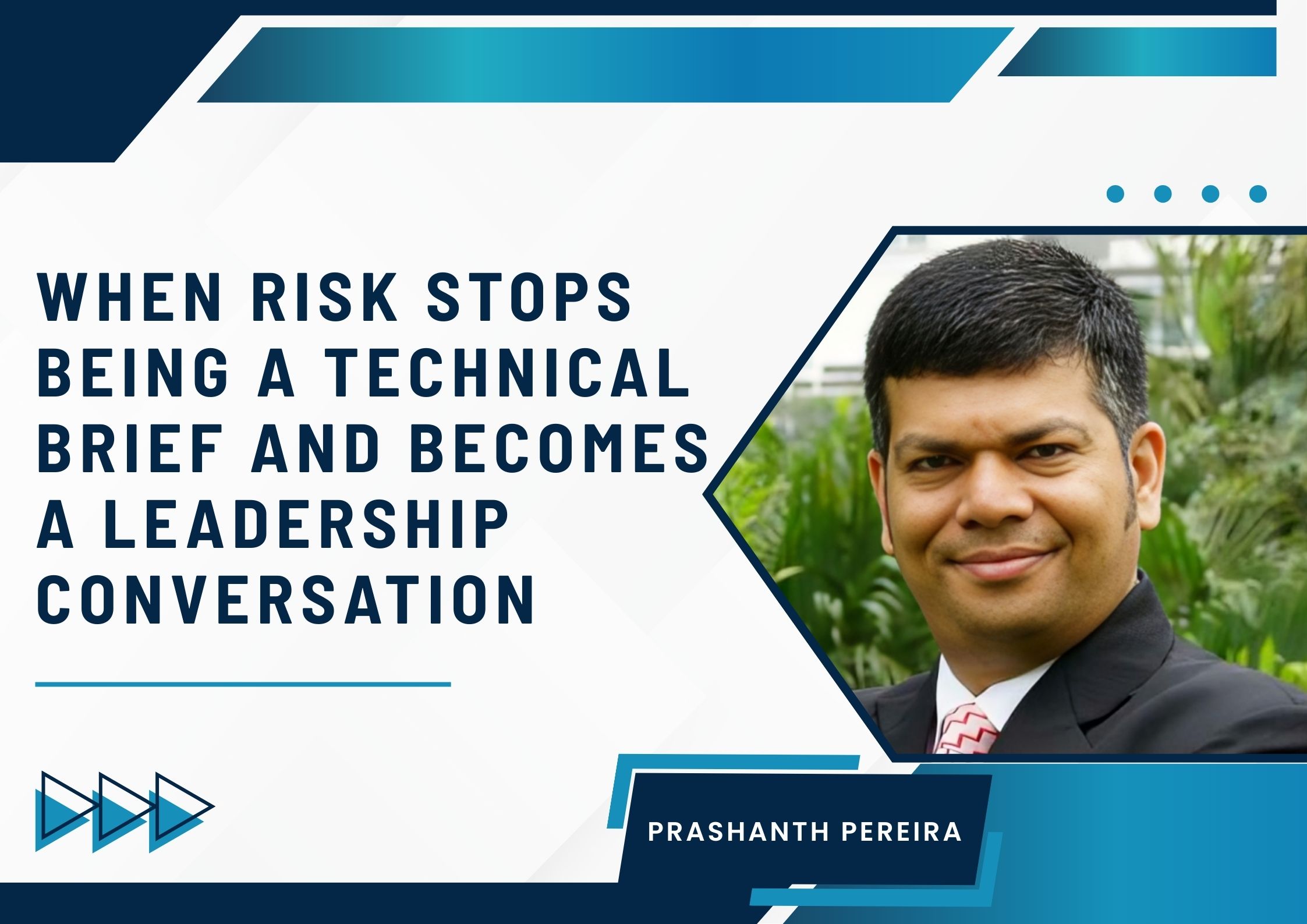
Prashanth Pereira is an Independent Director (IICA, IOD) and Regional Director- APAC/Africa/ME, at Miri Systems LLC (USA). A Digital Transformation Advisor for BFSI & Fintechs in India and Internationally. He specialises in enhanced tokenization, secure payments & authentication & new age technologies, Business & Market Strategy, Governance and risk-aligned digital strategy for regulated financial institutions & startups.
Disclaimer: Views expressed in the article are the personal opinions of the author.