




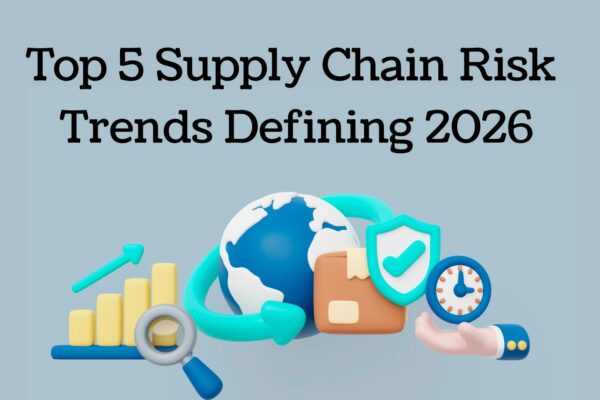
Top 5 Supply Chain Risk Trends Defining 2026

By 2026, supply chains are no longer in recovery mode. They are operating within a new normal defined by persistent disruption. What initially appeared as temporary shocks during the pandemic years has evolved into a long-term structural condition influenced by trade policy shifts, geopolitical realignments, resource constraints and systemic vulnerabilities. For both global and Indian…

Read More

Fraud, Deepfakes, and the Next Wave of Financial Crime: Why Trust Infrastructure Must Evolve

Financial crime has always adapted to technology. What is different today is the speed and asymmetry with which criminals can now manufacture trust. Deepfakes, voice cloning and generative AI have moved fraud from the margins of deception to its industrialisation. The result is a new wave of financial crime that targets not systems first, but…

Read More

Why OT Security Has Become a Factory Survival Issue

For decades, operational technology was treated as an engineering problem rather than a boardroom concern. Factory floors, power plants and logistics hubs ran on the assumption that isolation equalled safety. That assumption no longer holds. As manufacturing systems converge with IT networks and cloud platforms, operational technology (OT) has moved from the periphery of cybersecurity…

Read More

Operational Resilience as Competitive Advantage: The Companies That Recover Faster Win Market Share

For much of the past decade, operational resilience was treated as an insurance policy: costly, necessary, and largely invisible when things went right. Today, that framing is no longer sufficient. In an era marked by supply-chain fragmentation, cyber disruptions, climate volatility and abrupt shifts in capital flows, resilience has emerged as a source of competitive…

Read More

Boards Are Being Rewritten by Risk: What “Good Oversight” Looks Like in 2026

Boardrooms are being reshaped less by regulation than by risk. Across markets, directors are discovering that traditional governance frameworks, built for incremental change and stable assumptions, are increasingly misaligned with a world defined by volatility, technology shocks and geopolitical spillovers. By 2026, “good oversight” will no longer be measured by the number of committees formed…

Read More

Cyber Resilience Is Now a CEO Metric, Not a CISO KPI

For years, cybersecurity was treated as a technical function: delegated to the CISO, discussed in IT sub-committees and reviewed primarily through the lens of compliance. That era is decisively over. In today’s environment of AI-enabled threats, geopolitical cyber spillovers and digitally intertwined supply chains, cyber resilience has become a CEO-level metric, one that increasingly defines…

Read More

The AI Governance Gap: Why “Using AI” Isn’t the Same as “Controlling AI”

Artificial intelligence has moved faster into boardrooms than most previous technologies. In a matter of months, AI systems have been embedded into customer service, credit assessment, fraud detection, HR screening, software development and strategic analysis. For many organisations, the narrative is one of rapid adoption and visible productivity gains. Yet beneath this enthusiasm sits a…

Read More
Top