




Artificial intelligence has rapidly moved from experimentation to execution. Across industries, organizations are embedding AI into customer service, fraud detection, underwriting, supply-chain planning, document processing, compliance monitoring, analytics, and internal decision-making. As adoption accelerates, discussions around AI risk have largely focused on visible concerns such as cybersecurity, privacy, bias, hallucinations, regulatory compliance, and ethical governance.
These risks deserve attention. However, another challenge is quietly emerging beneath the surface of enterprise AI adoption: concentration within the infrastructure that powers AI itself.
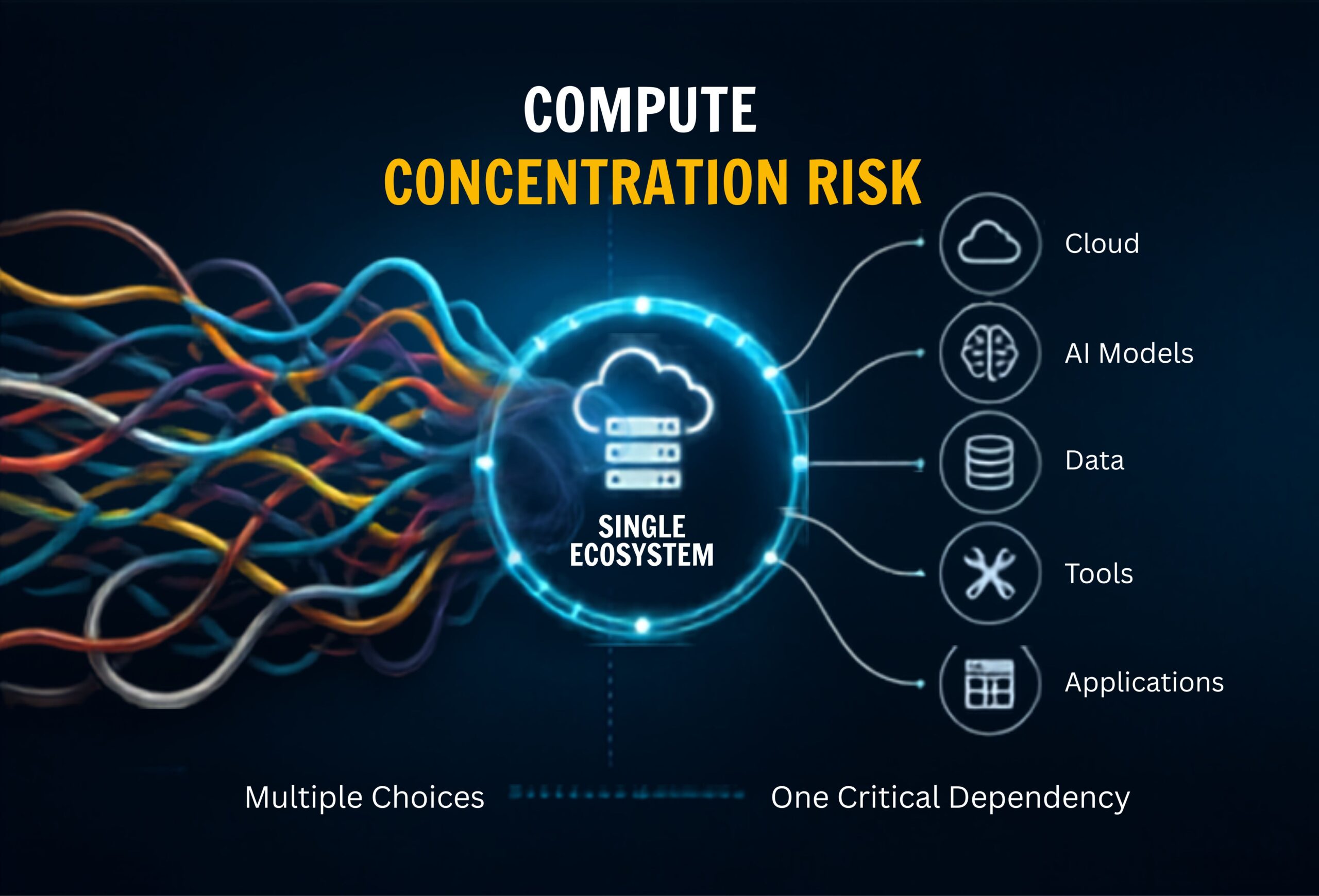
As organizations become increasingly dependent on a relatively small number of cloud providers, AI model developers, semiconductor manufacturers, and digital platform ecosystems, a new form of enterprise exposure is taking shape. This exposure is best described as compute concentration, the accumulation of critical business dependency on a limited set of external providers that supply the computational, data, and platform infrastructure required to operate AI-enabled systems.
Unlike traditional technology risks, compute concentration often develops gradually and remains difficult to detect until organizations examine the architecture supporting their most critical operations. By the time the dependency becomes visible, it may already be deeply embedded across business processes, customer channels, and operational workflows.
Why Compute Concentration Deserves Board-Level Attention
Most organizations do not intentionally design concentrated technology environments. In fact, concentration often emerges as a by-product of efficiency.
A company selects a cloud provider to accelerate digital transformation. Development teams then adopt additional services from the same ecosystem because integration is easier, deployment is faster and operational complexity is lower. Over time, storage, databases, identity management, analytics, observability tools, security controls and AI services become increasingly interconnected within a single technology stack.
The same pattern is becoming common in enterprise AI deployments. Organizations often standardize around one model provider because it offers superior performance, stronger documentation, better support or easier integration. As teams build prompts, workflows, governance frameworks, evaluation systems and internal expertise around that environment, switching becomes increasingly difficult.
The result is not necessarily a lack of vendor diversity on paper. An organization may maintain relationships with multiple software vendors while remaining heavily dependent on the same underlying cloud infrastructure, model ecosystem or compute platform.
This distinction matters because resilience is determined not by the number of contracts an organization holds, but by the number of meaningful alternatives available during disruption.
AI Growth Is Increasing Infrastructure Dependency
The issue has become more relevant as enterprise AI adoption moves beyond pilot projects.
Global investment in AI remains historically high, and organizations are increasingly deploying AI across revenue-generating and customer-facing functions rather than limiting it to experimentation. As AI becomes operationally critical, the infrastructure supporting those systems becomes part of an organization’s continuity, cost, governance and resilience profile.
At the same time, industry research indicates that significant investment, advanced model development, and high-performance computing capacity remain concentrated among a relatively small group of global technology firms. While this concentration has accelerated innovation and expanded access to powerful AI capabilities, it has also increased the degree to which organizations depend on shared infrastructure ecosystems.
The question is no longer whether companies use AI. The more important question is whether they understand the dependencies created by the way they use it.
Beyond Third-Party Risk: A Different Kind of Exposure
Many organizations instinctively classify compute concentration as a third-party risk issue. While there is overlap, the two concepts are not identical.
Traditional third-party risk programs focus on vendor due diligence, financial stability, cybersecurity controls, contractual obligations and regulatory compliance. These assessments remain essential, but they often fail to capture concentration across interconnected digital ecosystems.
For example, a company may rely on multiple technology vendors that appear independent. However, if those vendors ultimately operate on the same hyperscale cloud infrastructure, depend on the same AI model provider or rely on similar semiconductor supply chains, then the organization’s resilience profile may be less diversified than management reporting suggests.
The critical question is not how many suppliers an organization uses. The more important question is how many viable alternatives exist if a critical dependency becomes unavailable.
This is why compute concentration should be viewed as a resilience and strategic-autonomy issue rather than solely a vendor-management concern.
The Business Impact Extends Far Beyond System Outages
The most visible consequence of concentration is operational disruption.
Organizations increasingly rely on AI to support customer onboarding, fraud detection, claims processing, digital servicing, collections, underwriting and internal productivity functions. Disruption affecting these services can quickly translate into revenue loss, operational delays, customer dissatisfaction and reputational pressure.
However, downtime represents only one dimension of the risk.
Concentration can also create economic dependency. As organizations scale AI workloads, they may become increasingly tied to specific pricing structures, storage architectures, proprietary tools, and data-transfer models. Over time, switching costs can increase significantly, limiting flexibility and reducing negotiating leverage.
Governance challenges present another concern. Where critical AI capabilities depend on a single ecosystem for hosting, model access, orchestration, monitoring and logging, organizations may find it more difficult to maintain independent oversight, auditability, explainability, and compliance when providers change technologies, policies or commercial terms.
In this sense, compute concentration is not simply a technology issue. It can influence business agility, strategic flexibility and long-term competitiveness.
Concentration Is Not Always Negative
An important caveat is that concentration should not automatically be viewed as a problem.
Large cloud and AI providers often deliver significant benefits. They invest heavily in cybersecurity, resilience engineering, global infrastructure, redundancy, threat intelligence and innovation. In many cases, concentrating critical workloads with highly capable providers can improve operational stability relative to fragmented environments supported by smaller vendors. The objective is therefore not diversification for its own sake.
The challenge for organizations is determining when efficiency, convenience, and scale begin to create levels of dependency that exceed acceptable risk tolerance.
Resilience is not achieved by avoiding concentration altogether. It is achieved by understanding where concentration exists, evaluating its implications and implementing proportionate safeguards where necessary.
Why This Matters for India
For Indian enterprises, the conversation around compute concentration carries particular significance.
India’s digital economy continues to expand rapidly across banking, financial services, insurance, fintech, telecommunications, logistics, manufacturing, healthcare and e-commerce. Organizations are increasingly integrating AI into customer interactions, transaction monitoring, risk management and operational workflows.
This rapid adoption creates substantial opportunities, but it also increases reliance on shared technology infrastructure.
The issue is especially relevant in sectors where operational continuity, customer trust, and regulatory accountability are critical. Financial institutions, insurers, payment providers and digital platforms are expected to maintain resilient systems while managing increasingly complex technology ecosystems.
India’s Digital Personal Data Protection Act (DPDPA) has further elevated expectations around data governance, accountability, and risk management. While the legislation is not specifically focused on AI infrastructure concentration, it reinforces a broader regulatory direction that emphasizes transparency, control and responsibility over critical digital operations.
Similarly, regulatory frameworks across the financial sector increasingly emphasize operational resilience, outsourcing oversight, incident response and third-party dependency management. The underlying message is clear: organizations remain accountable for outcomes even when critical functions are supported by external providers.
As AI becomes integrated into core business processes, infrastructure dependency will inevitably become part of this broader resilience discussion.
Common Blind Spots Organizations Should Address
Many organizations have established governance frameworks for AI ethics, privacy, cybersecurity, and regulatory compliance. Yet concentration risks often remain underexamined.
One common blind spot is false diversification the assumption that multiple applications automatically create multiple sources of resilience. Several seemingly independent solutions may rely on the same underlying infrastructure.
Another challenge is the illusion of control. Strong contracts and service-level agreements provide important protections, but they do not necessarily guarantee operational substitutability during disruption.
A third weakness lies in scenario planning. Organizations frequently test cyber incidents and technology failures while paying less attention to provider exits, geopolitical restrictions, regulatory divergence, model retirement or significant pricing changes.
These scenarios may appear unlikely during stable periods, but resilience planning exists precisely because unexpected events occur.
A Practical Framework for Managing Compute Concentration
Organizations do not need to eliminate concentration. Instead, they should focus on understanding and governing it.
The starting point is identifying which AI-enabled processes are genuinely critical to business operations. Not every workload requires redundancy, but every critical process should have clearly understood dependencies.
The next step is dependency mapping. This involves tracing key business processes through cloud infrastructure, AI models, storage systems, identity services, orchestration layers, APIs and significant subcontracted technology components.
Organizations should then assess substitutability rather than simply counting vendors. If migration would require extensive redesign, prolonged downtime or unacceptable degradation in performance, concentration may be higher than management realizes.
Scenario testing is equally important. Organizations should evaluate how critical operations would respond to provider outages, API restrictions, model deprecation, data-localization requirements, geopolitical disruptions or sudden commercial changes.
Finally, boards and executive leadership teams should receive clear reporting on critical dependencies, concentration exposure and resilience measures. Effective governance begins with visibility.
The Next Phase of AI Risk Management
The next stage of AI governance will extend beyond questions of ethics, cybersecurity and compliance. Increasingly, organizations will need to examine the infrastructure dependencies that underpin AI-enabled operations.
Compute concentration is emerging as a distinct enterprise risk category that sits at the intersection of technology, resilience, governance, economics and strategy.
Globally, the issue reflects the concentrated structure of the AI economy and the growing influence of cloud infrastructure, semiconductor ecosystems and platform providers. In India, it intersects with accelerating digital adoption, operational resilience expectations and increasing reliance on technology-enabled business models.
The most important lesson is practical rather than theoretical. Organizations should not assume that rapid AI adoption automatically translates into resilience. The same infrastructure that enables innovation can also create hidden dependencies if concentration is not measured, tested and governed appropriately.
Companies that understand those dependencies early will be better positioned to balance innovation, efficiency, cost and resilience in an increasingly AI-driven economy.