





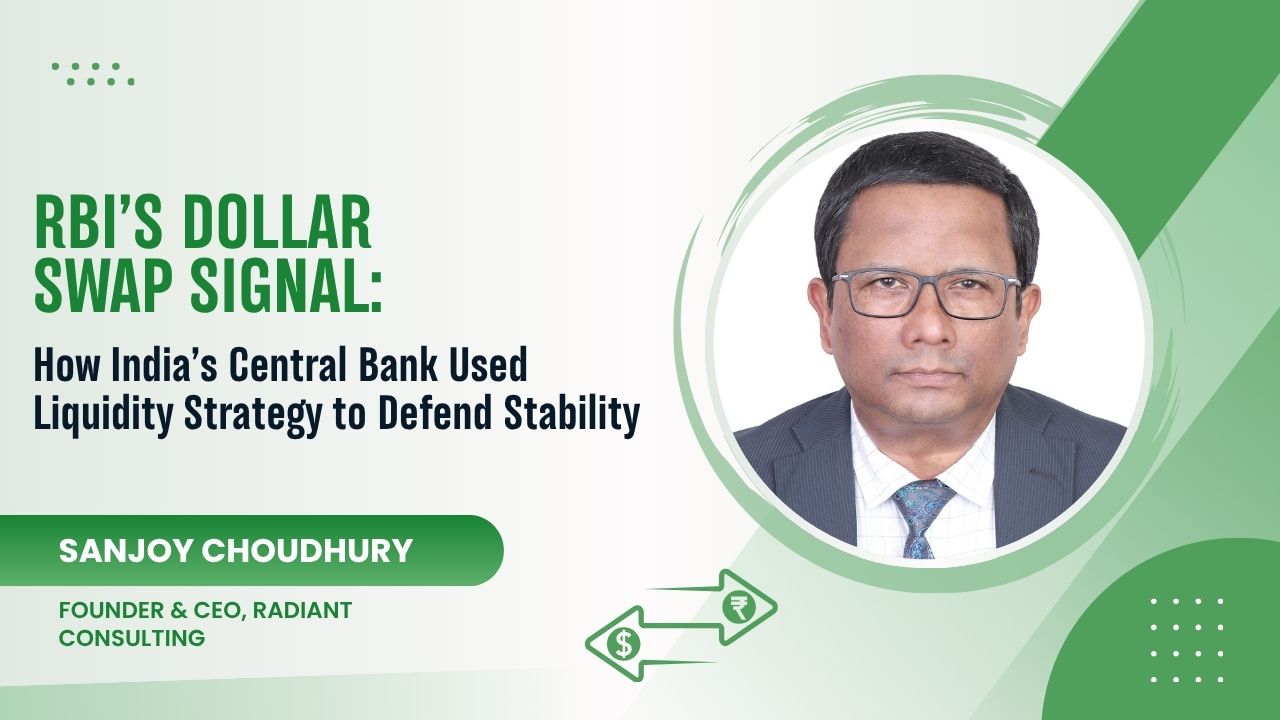
Sanjoy Choudhury, Founder & CEO, Radiant Consulting
At a time when the Indian rupee was approaching psychologically sensitive lows and global uncertainty was intensifying, the Reserve Bank of India’s USD 5 billion USD/INR buy-sell swap auction on 26 May 2026 emerged as far more than a routine foreign exchange operation. It was a calibrated macro-financial intervention designed to achieve multiple objectives simultaneously: stabilising the currency, preserving domestic liquidity, easing stress in forward markets and reinforcing confidence in India’s monetary management framework.
A Currency Defence Operation with a Broader Monetary Objective
The RBI’s intervention came amid a difficult external environment. The rupee had weakened sharply and briefly moved towards the ₹97-per-dollar mark, reflecting a combination of rising crude oil prices, geopolitical instability in West Asia, sustained foreign institutional investor outflows and broad-based strength in the US dollar globally.
To contain excessive volatility, the RBI had already been active in the spot foreign exchange market through dollar sales from its reserves. However, such interventions come with a domestic liquidity cost. When the central bank sells dollars, it absorbs rupee liquidity from the banking system, tightening financial conditions over time.
This created a policy balancing act. The RBI needed to continue defending the rupee without triggering an unintended liquidity squeeze that could disrupt credit flows and financial-market stability.
The three-year swap structure provided that balance. Under the arrangement, banks sold dollars to the RBI and received rupees in return, with an agreement to reverse the transaction after three years at a pre-agreed premium. The mechanism effectively injected nearly ₹42,000–43,000 crore of durable liquidity into the banking system while allowing the RBI to continue its currency-stabilisation efforts.
More importantly, the operation underscored the RBI’s increasingly sophisticated approach to liquidity management — one that integrates exchange-rate stability with domestic monetary conditions rather than treating them as separate policy silos.
Strong Market Participation Reflects Confidence in the RBI Framework
The market response to the auction was notably strong. Against the notified amount of USD 5 billion, the RBI received bids worth nearly USD 9.8 billion, reflecting close to two-times oversubscription. The central bank accepted 141 bids, with the cut-off premium settling at ₹9.10 per USD.
The level of participation indicated more than just demand for liquidity. It suggested that banks viewed the RBI’s framework as credible, timely and commercially viable in an environment of tightening domestic liquidity and elevated currency volatility.
Forward market pricing also responded positively. Three-year forward premiums moderated after the auction, signalling easing stress in the FX derivatives market and improved confidence around liquidity expectations.
While the rupee itself remained vulnerable to external variables such as oil prices and geopolitical developments, the RBI successfully conveyed an important message to markets: India’s central bank retained both the reserves and the policy flexibility necessary to manage periods of elevated volatility.
That signalling effect may ultimately prove as important as the liquidity injection itself.
Why the Swap Matters for Banks and Financial Markets
For the banking system, the operation provided stable long-term rupee funding at a time when liquidity conditions were tightening. This improved treasury flexibility, supported asset-liability management and reduced near-term funding stress. Banks with surplus dollar holdings were also able to temporarily monetise those balances while retaining the right to recover the dollars after three years.
From the RBI’s perspective, the swap offered a more elegant policy tool than outright reserve depletion or large-scale bond purchases.
Unlike direct spot-market intervention, the transaction did not permanently reduce India’s foreign exchange reserves because the dollars will return to banks at maturity. At the same time, the RBI was able to inject rupee liquidity in a controlled and reversible manner without relying excessively on conventional durable liquidity measures.
The operation also helped moderate elevated forward premia, thereby easing hedging costs for importers and exporters at a time when currency risk management had become increasingly important for Indian corporates.
A Broader Signal on India’s Macro-Financial Resilience
The economic implications of the swap extend beyond immediate liquidity conditions. By preventing an excessive tightening of domestic liquidity, the RBI reduced the probability of funding stress within the banking system and supported the broader credit environment.
The intervention also carried inflation-management implications. A disorderly depreciation in the rupee would have amplified imported inflation pressures through higher oil prices, more expensive imports and rising industrial input costs. Stabilising the currency therefore became not merely an FX-market objective, but part of a wider macroeconomic stabilisation effort.
At the same time, the RBI remains aware that no swap operation can permanently alter structural drivers of currency movements. Oil prices, US Federal Reserve policy, capital flows, India’s current-account position and global risk sentiment will continue to shape the medium-term trajectory of the rupee.
Yet the significance of the May 2026 swap lies precisely in its demonstration of institutional agility. In an increasingly volatile global environment, modern central banking is no longer about singular policy levers. It is about deploying interconnected instruments — liquidity, reserves, signalling and market confidence — in a coordinated manner.
The RBI’s USD 5 billion swap auction ultimately reinforced a critical message to financial markets: India’s monetary authorities remain prepared to use sophisticated balance-sheet tools not only to defend the currency, but to preserve broader macro-financial stability during periods of external stress.
About The Author
Sanjoy Choudhury is a seasoned banking strategist and leadership trainer with over three decades of experience at the intersection of financial markets, risk management, macroeconomics and value creation in financial services.
As the Founder & CEO of Radiant Consulting, he advises financial institutions on navigating economic cycles, managing risk intelligently and translating macroeconomic shifts into business opportunities. His work spans consulting, training, analytics and advisory across global banking and capital markets institutions.