





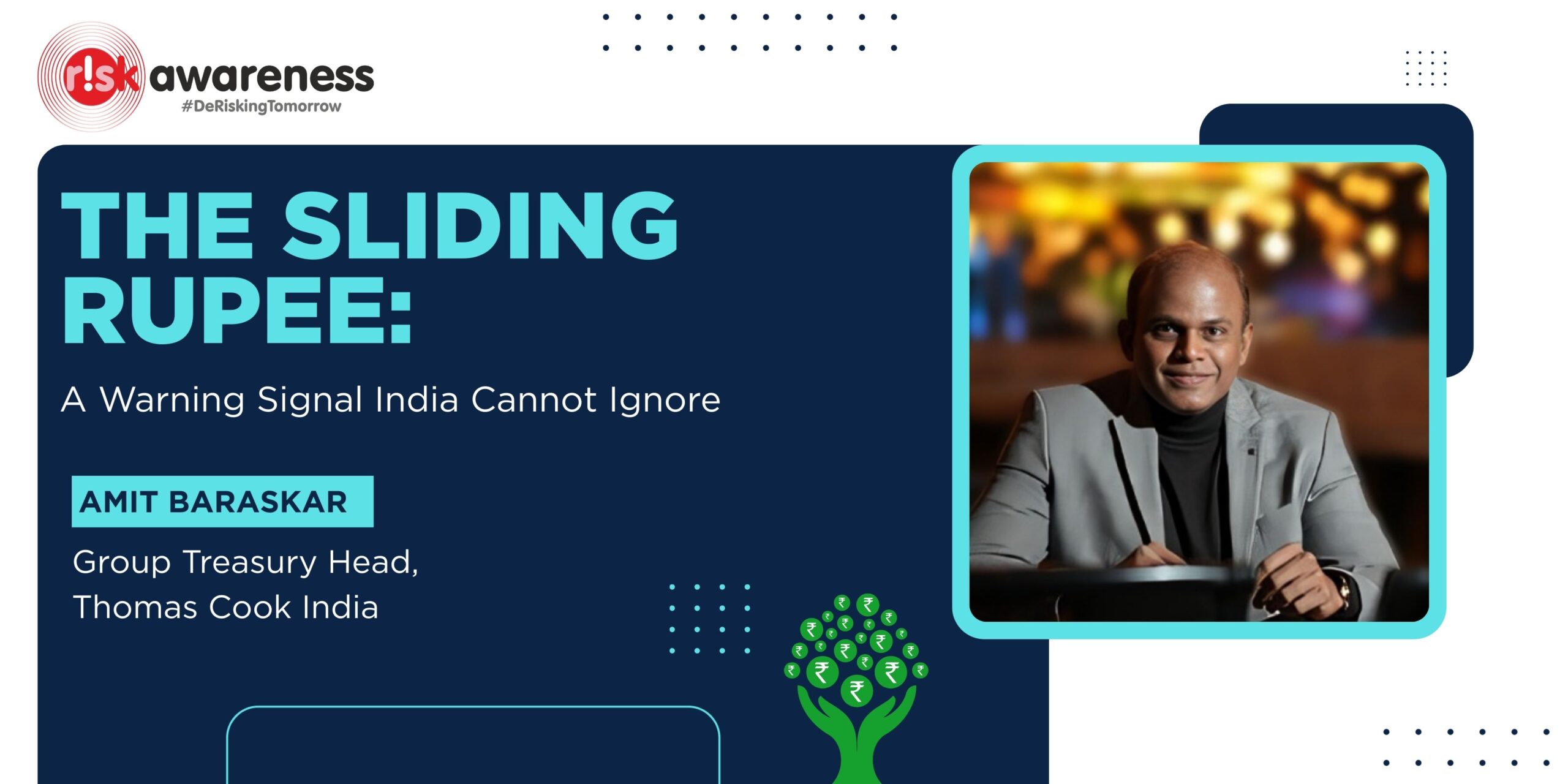
By Amit Baraskar
Treasury Head, Thomas Cook India
Currency weakness is often dismissed as cyclical noise. But when depreciation becomes persistent, broad-based and regionally uncompetitive, it stops being a market fluctuation and starts resembling a policy signal. The recent slide of the Indian rupee belongs firmly in the latter category.
While several foreign banks continue to project the rupee moving towards 86–87 levels, anchored on expectations of a successful India–US trade arrangement in the first half of 2026, the more immediate reality is sobering. The rupee has emerged as one of the worst-performing Asian currencies, a development that should serve as a clear wake-up call rather than a temporary inconvenience.
Markets rarely punish without reason.
To be sure, a move towards ₹100 per dollar would require an extreme confluence of adverse factors, a perfect storm. But currency crises are rarely born overnight; they are incubated in phases of inaction. Absent serious, coordinated and outcome-oriented measures, the rupee drifting beyond the ₹93 mark by H1 2026 is no longer implausible.
The asymmetry of impact is already visible. Exporters may temporarily benefit from a weaker currency, but importers face mounting cost pressures, feeding directly into domestic inflation. For an economy with significant energy, technology and intermediate-goods imports, sustained currency weakness is less a competitive advantage and more an embedded macro risk.
Paradoxically, the longer-term outlook for the rupee remains constructive. India’s structural growth story, demographic dividend and expanding manufacturing base should, over time, support a stronger rupee in the 84–80 range. But currencies do not travel in straight lines. Reaching that destination will require consistency in policy execution, patience from markets and credibility across trade, capital flows and fiscal management.
At present, however, the contributors to rupee stress are accumulating rather than dissipating.
Delayed progress on key trade agreements, including with the United States, has dampened sentiment. Foreign portfolio investors have withdrawn over USD 18 billion from Indian equities on a year-on-year basis, tightening dollar liquidity. Record trade deficits continue to widen the current account gap. Fresh tariff actions, such as Mexico’s 50% tariff on select Indian goods, have further clouded the external outlook. Taken together, these factors represent not isolated shocks, but a compounding drag.
The pressure is even more visible in the forward markets.
India entered mid-2026 with a materially altered interest-rate landscape. The Reserve Bank of India delivered three rate cuts between February and June, supporting growth but narrowing the rate buffer. Meanwhile, between September and December 2025, the US Federal Reserve cut rates three times in four months, widening the interest-rate differential in unexpected ways.
The result was a sharp rise in forward premiums and currency swap costs, pushing them into the 1.8–2.0% range through mid-December. By the third week of December, forward premiums spiked to over 6.6%, the highest level seen in six years, an unmistakable signal of rupee liquidity stress, particularly as year-end trade settlements converged.
Forward markets are often the first to reflect underlying imbalance. Elevated premiums indicate not just rate arbitrage, but a shortage of rupees, rising hedging demand and heightened uncertainty about near-term currency stability.
For corporate treasurers, this environment requires recalibration. Passive hedging assumptions built around stable differentials no longer hold. For policymakers, the message is equally clear: currency stability cannot be outsourced to optimism about future trade deals or long-term fundamentals alone.
The rupee does not need dramatic intervention. What it needs is policy coherence: on trade, capital flows and inflation control, communicated clearly and executed consistently. Markets are patient with strategy; they are unforgiving of drift.
India’s currency story is far from broken. But the recent slide is not benign. It is a signal: quiet, persistent and increasingly difficult to ignore.
Disclaimer: Views expressed in the article are entirely the personal opinions of the author and do not reflect the views of Thomas Cook India, its subsidiaries or associated companies.