



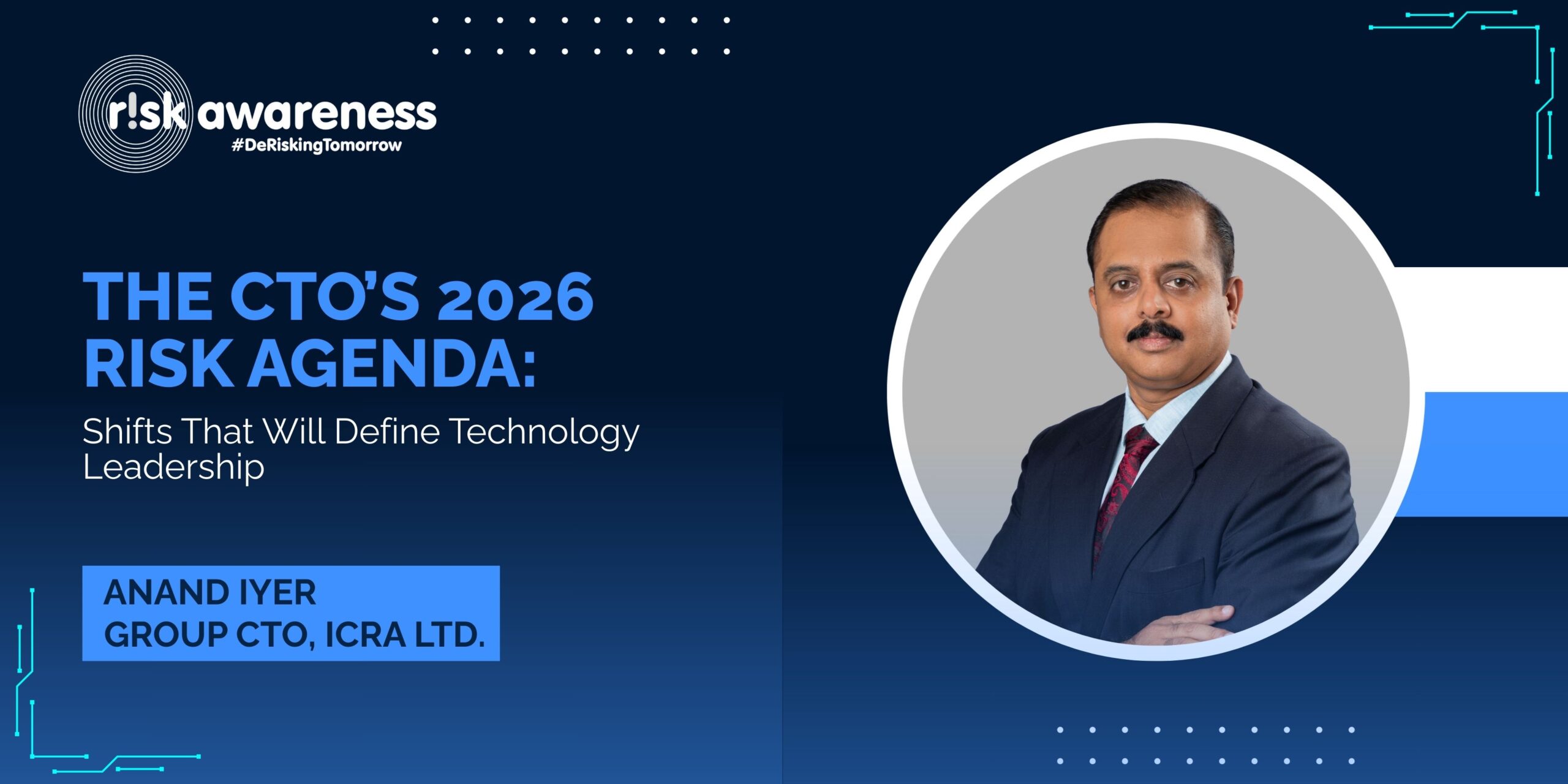
By Anand Iyer
Group Chief Technology Officer, ICRA
By 2026, the CTO’s mandate will be judged less by the speed of delivery and more by the quality of endurance: how well the enterprise withstands shocks, preserves trust and proves control over increasingly autonomous digital systems. The backdrop is a risk environment where cyber incidents, regulatory enforcement, AI misuse and geopolitical fragmentation reinforce one another, turning “isolated” technology issues into enterprise-level crises.
1) From cyber defense to measurable resilience
Cybersecurity has become a business interruption problem. Breach research shows ransomware remains deeply embedded in modern intrusion patterns, while threat landscapes continue to rank availability attacks as a prime concern. In this environment, boards care about time-to-detect, time-to-recover, decision cadence, and crisis communications as much as technical controls. The CTO’s 2026 agenda must therefore hardwire resilience: tested recovery paths, immutable backups, segmented architectures and rehearsed incident command structures that operate across technology, risk, legal and communications.
2) Identity becomes the new perimeter
The most scalable attacks exploit identities and weak remediation, not firewalls. Data shows credential abuse and vulnerability exploitation remain leading initial access paths, and patch/secret remediation windows can stay open long enough to be operationally fatal. CTOs must treat identity as critical infrastructure: strong authentication, least privilege, continuous verification, secrets hygiene and rapid exposure response, especially across contractors and partners where the blast radius is growing.
3) Third-party risk evolves into concentration risk
Digital business is now a web of SaaS platforms, cloud providers, APIs, and managed service partners. Breach reporting points to a sharp rise in third-party involvement, underscoring that “uptime” is often determined by someone else’s controls. 2026 leadership requires mapping critical dependencies, quantifying concentration exposure, negotiating enforceable resilience SLAs and designing graceful degradation, because the enterprise boundary is no longer a meaningful security boundary.
4) Software supply chain security moves to the front page
A defining shift is the move from managing “systems” to managing components and provenance. Security agencies and standards bodies increasingly emphasize SBOMs and secure development practices because modern attacks weaponize build-pipelines, open-source dependencies, and update channels. CTOs must establish engineering assurance: signed builds, controlled CI/CD, dependency governance, SBOM consumption and rapid component-level remediation, turning software integrity into a continuously monitored discipline.
5) AI governance: from ethics to enforcement and assurance
AI is no longer a lab experiment; it is production infrastructure. Risk frameworks stress lifecycle governance knowing what models do, how they are evaluated, where training data came from, and how outputs are monitored. Simultaneously, regulatory timelines are tightening: governance requirements mature, and regulatory implementations arrive in 2026, pushing enterprises toward audit-ready documentation, traceability, and controls. CTOs must design AI with evidence: explainability, logging, model monitoring, human oversight and incident response for AI failures.
6) Information integrity and digital trust become competitive differentiators
The next wave of risk is not only data theft, but truth decay: synthetic media, narrative attacks and misinformation, undermining brands and market stability. Global risk assessments place misinformation/disinformation among the most severe near-term threats, while AI regulations increasingly expect transparency and labeling for synthetic content. CTOs will need technical and governance controls: content provenance, detection, platform monitoring and rapid response, to protect trust as a measurable enterprise asset.
7) Financial governance of cloud and AI spend becomes a risk control
Cloud agility has introduced cost volatility, and FinOps research shows a shift toward governance and policy at scale, expanding beyond public cloud into SaaS and AI spend. In 2026, financial discipline becomes part of architecture: unit economics, capacity guardrails, workload right-sizing, and automated policy enforcement. The CTO must link design choices to controllable cost outcomes, because uncontrolled consumption is now a balance-sheet risk.
8) Crypto-agility and post-quantum readiness emerge as “silent debt”
Quantum-resistant standards are available and migration guidance urges organizations to begin now, because cryptography is deeply embedded and slow to replace. CTOs should inventory cryptographic dependencies, prioritize high-risk data flows, and build crypto-agility into platforms so future migrations are operationally feasible. This is a classic 2026 risk: invisible today, irreversible tomorrow if ignored.
The central shift is this: the CTO is becoming a core risk leader, owning not only technology outcomes, but institutional resilience and trust. The most effective 2026 agendas will balance innovation with provable control: resilient operations, governed AI, assured software supply chains, and architectures that anticipate geopolitical and regulatory friction rather than reacting to it.
Disclaimer: Views expressed in the article are entirely the personal opinions of the author and do not reflect the views of ICRA Ltd., its subsidiaries or associated companies.