





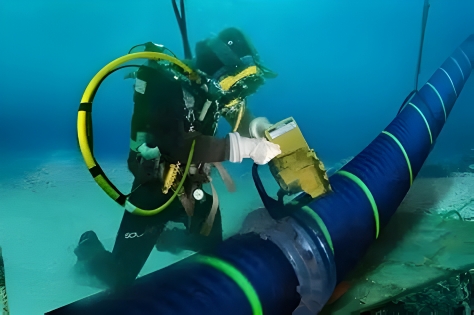
When tensions escalate in the Red Sea or around the Strait of Hormuz, attention predictably turns to oil cargoes, naval patrols and maritime insurance premiums. War risk surcharges rise, container vessels reroute and energy markets react within minutes. Yet beneath these waters lies infrastructure arguably more consequential to the modern economy than crude shipments: dense clusters of subsea fibre optic cables carrying nearly 95 percent of global internet traffic.
These cables are the physical backbone of cross-border finance, hyperscale cloud computing, defence communications, digital public infrastructure and real-time enterprise operations. They are privately owned, commercially operated and largely invisible to the public. But they sit squarely at the intersection of cyber resilience, geopolitical competition and systemic financial stability.
In an era marked by conflict spillovers in West Asia, attacks on commercial shipping, and rising naval deployments across strategic chokepoints, the question is no longer theoretical. It is operational: what happens to the global digital economy if these corridors are disrupted not for hours, but for weeks?
The 95% Dependency Most Risk Models Underestimate
Satellites dominate public imagination, but they carry only a fraction of global traffic. Roughly 550 active submarine cable systems, spanning about 1.3 million kilometres, support virtually all cross-border digital flows. SWIFT financial messages, high-frequency trading signals, defence data exchanges, cloud synchronisation traffic and multinational ERP systems all traverse these fibre pairs resting quietly on the seabed.
This creates an asymmetric vulnerability. Enterprises have invested billions in cybersecurity to defend against logical attacks, yet the physical layer remains concentrated in a handful of maritime corridors.
The Red Sea alone hosts more than a dozen high-capacity systems linking Asia to Europe. Many converge at Egyptian landing stations before branching into Mediterranean routes. Similarly, traffic through the Arabian Gulf must navigate proximity to the Strait of Hormuz, a waterway repeatedly in focus during regional escalations.
The Millisecond Economy’s Achilles Heel
Traditional business continuity frameworks assume binary outcomes. Systems are either available or unavailable. Subsea cable risk introduces a third state that is more destabilising: degraded performance.
This degradation does not trigger dramatic outages. Instead, it alters system behaviour in subtle but economically significant ways.
Latency budget exhaustion is one example. A 20 to 30 millisecond increase in round-trip time between Mumbai and Frankfurt may fall within technical tolerance, yet it can render certain high-frequency trading strategies economically unviable. The infrastructure remains “up,” but the business model weakens.
Longer rerouted paths also affect TCP window scaling and bandwidth-delay product calculations. Throughput efficiency can drop sharply even when nominal capacity exists. Distributed databases relying on cross-region replication may encounter consensus timeouts as round-trip times rise from sub-100 milliseconds to 300 milliseconds or more. Failover systems built for isolated outages struggle under sustained congestion.
In financial markets, where microseconds influence price discovery and arbitrage, such shifts can amplify volatility during already fragile geopolitical periods.
The Repair Reality Few Boards Appreciate
Globally, only around 60 specialised repair vessels are available. Allocation is governed by commercial contracts and maritime law, not geopolitical importance. A cable carrying interbank payment traffic does not automatically receive priority over one serving consumer streaming services.
Depth compounds complexity. At abyssal depths exceeding 6,000 metres, remotely operated vehicles retrieve cables using techniques that have changed little since the nineteenth century. Grappling hooks are still dragged across the seabed to locate damaged segments. In cable-dense areas, identifying the correct fibre pair adds further delay.
In conflict-affected waters, vessels require multi-jurisdictional permits. A spike in naval activity, denial of port access, or restricted territorial waters can extend repair timelines from days to weeks.
Concentration Risk and the Red Sea Mathematics
The Red Sea is not merely a transit corridor. It is a concentration multiplier.
Cable systems cluster around limited landing stations. Egypt’s facilities process the overwhelming majority of traffic moving between Asia and Europe through this route. A localized disruption at a landing station, whether physical or regulatory, cascades across continents.
Shallow waters in parts of the southern Red Sea place cables within anchor-drag range during maritime instability. Compared with deep Atlantic routes averaging several thousand metres, these sections lack natural depth protection.
During heightened tensions, even routine repair operations may require diplomatic coordination across multiple states. In such scenarios, digital risk becomes inseparable from maritime geopolitics.
Financial System Exposure: The Hidden Dependencies
Cross-border payment systems, correspondent banking channels and foreign exchange platforms rely on low-latency synchronisation.
SWIFT maintains redundancy at the data centre level, but message routing algorithms still follow optimised network paths. Disruptions may not halt messaging, yet delays can stretch from minutes to hours, tightening liquidity windows in volatile markets.
Foreign exchange markets aggregate pricing across continents in real time. Latency asymmetry can distort arbitrage dynamics, particularly during stress events. Central bank digital currency pilots assume stable sub-second cross-border connectivity. Prolonged cable disruptions could undermine confidence in emerging digital settlement infrastructures.
Operational resilience, therefore, has a geopolitical dimension that no single institution can independently mitigate.
Cloud Architecture and the Illusion of Diversity
Multi-region cloud deployments are often marketed as geographically resilient. Yet physical path diversity is rarely transparent.
Multiple hyperscale providers may lease capacity on the same cable systems. Logical failover testing validates endpoint availability, not seabed route independence. Primary and backup paths can diverge in routing tables yet converge in the same maritime chokepoint.
Edge computing nodes designed to localise processing may become isolated islands without reliable backhaul connectivity.
India’s Strategic Exposure
India’s expanding digital economy, fintech exports and global capability centres depend heavily on connectivity through West Asia. International cable landing stations in Mumbai and Chennai route traffic via the Arabian Sea toward the Red Sea corridor.
Semiconductor design collaboration, financial reporting by global capability centres and cross-border digital public infrastructure exports rely on consistent latency and bandwidth. A prolonged disruption would not merely slow downloads. It could trigger regulatory non-compliance, settlement delays and contractual penalties.
Digital sovereignty discussions must therefore extend beyond data localisation toward route resilience and corridor diversification.
Beyond Generic Risk Registers
Decision makers should consider specific structural adjustments:
• Define latency-adjusted service level agreements that account for performance degradation, not just uptime.
• Demand transparency on physical cable routes from carriers and cloud providers.
• Integrate maritime risk intelligence into network operations monitoring.
• Explore terrestrial alternatives across Eurasia despite geopolitical complexity.
• Participate in collaborative capacity or repair consortium models to reduce queue dependency.
The Uncomfortable Conclusion
The global digital economy rests on infrastructure that predates the internet yet determines its resilience. While cyber defences have matured, physical concentration risk beneath contested waters remains underappreciated.
The next systemic digital shock may not originate from malware or state-sponsored intrusion. It may begin with an anchor drag, a denied repair permit or prolonged naval standoff in a narrow maritime passage.
In a world where microseconds define competitive advantage and geopolitical tensions remain elevated, subsea cable resilience is no longer a technical afterthought. It is a strategic imperative.