




For much of modern banking history, commercial relationships were largely defined by one question: How much capital does a business require?
That question is rapidly becoming obsolete.
Today’s enterprises operate in an environment shaped by supply-chain disruptions, geopolitical uncertainty, digital transformation, cyber threats, sustainability expectations and increasingly complex regulatory frameworks. Access to finance remains important, but increasingly it is only one component of what businesses expect from their banking partners.
Against this backdrop, commercial banking itself is undergoing a profound transformation, from transaction-led financing towards strategic enterprise enablement.
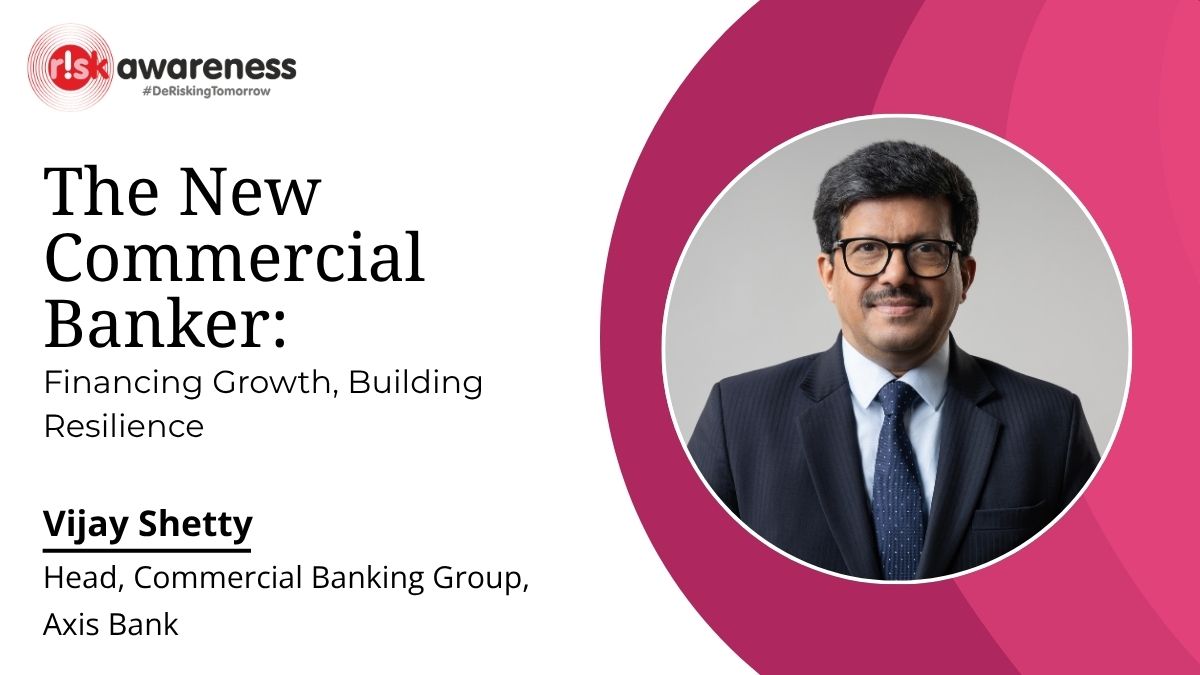
Few executives have witnessed this transition as closely as Vijay Shetty, Head – Commercial Banking Group, Axis Bank, who has spent nearly three decades across lending, risk management, underwriting, digital transformation and portfolio management. Under his leadership, the commercial banking franchise has increasingly focused on building integrated solutions for India’s MSME ecosystem, combining financing with technology, advisory capabilities and ecosystem partnerships.
In this edition of CXO Thought Leader, Vijay argues that the future competitiveness of Indian enterprises will depend not merely on greater access to capital, but on stronger financial discipline, better governance, intelligent use of technology and an organisational ability to anticipate disruption before it arrives.
His central thought leadership message is both timely and compelling: the banks that create the greatest value over the next decade will not simply finance businesses; they will help make them more resilient.
India’s MSME sector is expected to contribute significantly towards the country’s Viksit Bharat vision. In your view, what are the three biggest structural changes commercial banks must make to truly become growth partners for Indian businesses rather than just providers of capital?
India’s MSMEs today look to a bank for partnership in their growth journey, well beyond capital alone. Three structural shifts matter most. First, adopting AI and data, so credit decisions become faster, fairer and available in near real time, bringing more first-time borrowers into the formal fold. Second, simplifying operations, so approvals, renewals and everyday servicing move at the speed of business. Third, becoming a holistic partner across their entire journey and stages, beyond just a transaction-oriented approach, from advisory and knowledge to ecosystem support that helps an enterprise manage cash, trade, compliance and growth under one roof. These are the qualities an MSME seeks from a trusted partner. A confident, competitive MSME base sits at the heart of the Viksit Bharat vision of a developed India by 2047, with the sector already contributing about 31% of GDP (Economic Survey of India, FY26). At Axis Bank, this is exactly how we are shaping our commercial banking franchise.
Today’s commercial banking relationship extends far beyond lending. How do you see the role of banks evolving in helping SMEs manage risks around working capital, global trade, digitalization and regulatory compliance?
Today’s commercial bank is a one-stop partner across an enterprise’s growth journey, working well beyond lending to help SMEs navigate risk with confidence. On working capital, banks manage liquidity risk through credit lines, supply chain finance, invoice discounting and cash management solutions that shield businesses from payment delays and demand cycles. On global trade, they cushion importers and exporters from currency volatility, geopolitical shifts and counterparty risks through trade finance, forex advisory and hedging. On digitalization, secure platforms, integrated payments and API-led banking reduce operational and fraud risks. On compliance, intuitive digital rails simplify GST, statutory filings and reporting, keeping SMEs focused on core priorities. At the core sit two enablers: the right industry-tailored banking mix, and advisory on cash flow planning, risk cover, market entry and succession that builds long-term resilience. At Axis Bank, our Evolve and Digital Evolve series carry this practical guidance to Tier 2 and Tier 3 enterprises.
Technology is fundamentally changing commercial banking, from AI driven credit assessment to embedded finance and real time cash flow analytics. Which innovations do you believe will have the greatest impact on SME banking over the next five years?
Over the next five years, four shifts will define SME banking. AI-led credit assessment will read cash flows, GST and transaction data to judge repayment capacity in near real time, bringing more first-time borrowers into formal credit. Embedded finance will place credit and payments where business actually happens, inside supply chains, marketplaces and accounting platforms. Real-time cash flow analytics will let owners and banks see stress early and act on it before it becomes a problem. Together, these move the model from collateral-first to cash flow-first, so a sound business is judged on how it actually performs. Banks that build these capabilities well will serve more MSMEs, faster.
Having worked closely with businesses across industries, what common characteristics distinguish companies that consistently earn the confidence of banks, investors and other financial stakeholders?
In my experience, companies that consistently earn confidence share a few habits. They keep clean, transparent books and file on time, so their numbers tell a clear story. They manage cash with discipline, holding a reserve and respecting working capital cycles. They diversify across customers, suppliers and markets, so no single shock defines them. They invest in governance and a capable second line of leadership, so the business runs well even when the promoter steps back. They adopt technology to stay efficient and well-informed, and they plan for risk rather than reacting to it. Above all, they communicate openly and they honor their commitments to lenders and partners. Confidence follows predictability. A business that is transparent, disciplined and well governed becomes easy to understand, easy to fund and easy to trust and that reputation compounds into better access and better terms over time.
As Indian enterprises increasingly look beyond domestic markets, what should SME promoters focus on today to build globally competitive and financially resilient businesses over the coming decade?
To compete globally over the coming decade, promoters should build a Resilience Framework across six fronts. First, hold a liquidity buffer before you need it, keeping an operating reserve. Second, map your supply chain two tiers deep and line up an alternative source for every critical input. Third, build technology and AI into daily operations, from forecasting to collections. Fourth, layer your protection, from currency hedging to cyber cover, across financial, physical and digital risks. Fifth, make sustainability part of how you run, as global buyers and rules like the EU carbon border mechanism now expect cleaner credentials. Sixth, plan for continuity beyond the founder. The enterprises that will stand out globally are those that combine financial discipline, operational agility, innovation and strong governance, making them adaptable to change while remaining focused on long term growth.
If you had one piece of advice for the next generation of Indian entrepreneurs seeking to build enduring businesses, what would it be and why?
If I could offer one piece of advice to the next generation of Indian entrepreneurs, it would be this: stay closely attuned to evolving customer expectations and emerging market shifts, while remaining financially prudent in every phase of growth. Enduring businesses are built by those who anticipate change before it becomes obvious, adapt with agility and have the conviction to rethink their own assumptions. Enduring businesses are patient; they compound steadily and resist the lure of shortcuts. They stay adaptable, treating each disruption as a prompt to evolve rather than a reason to retreat. They build several revenue streams, so no single market or customer decides their fate. To that, I would add a few more habits: keep your finances clean and your promises kept, invest early in people and technology, protect the business with the right cover and stay close to the customer, whose changing needs are the best guide to where you go next.
The RiskAwareness Perspective
One of the strongest themes emerging from this conversation is that business resilience is increasingly becoming a boardroom priority rather than an operational consideration. As enterprises navigate economic uncertainty, supply-chain disruptions, technology-led transformation and evolving regulatory expectations, access to capital alone is no longer sufficient to sustain long-term growth. Organisations must build stronger foundations across governance, liquidity management, digital capabilities and risk preparedness.
Vijay Shetty’s insights also highlight the changing role of commercial banks in this environment. The future of banking extends beyond financing transactions; it involves helping businesses improve visibility, strengthen financial discipline, manage emerging risks and make more informed strategic decisions. Whether through AI-driven credit assessment, embedded finance, cash-flow intelligence or advisory support, banks are increasingly becoming partners in enterprise resilience rather than simply providers of credit.
For Indian businesses aspiring to scale sustainably in the coming decade, the message is resilience and competitiveness are becoming inseparable. The enterprises will have to combine financial prudence, technological adoption, operational agility and strong governance to be best positioned to navigate uncertainty and capture future opportunities. In that journey, the most valuable banking relationships may well be those that help organisations prepare for disruption before it arrives.